
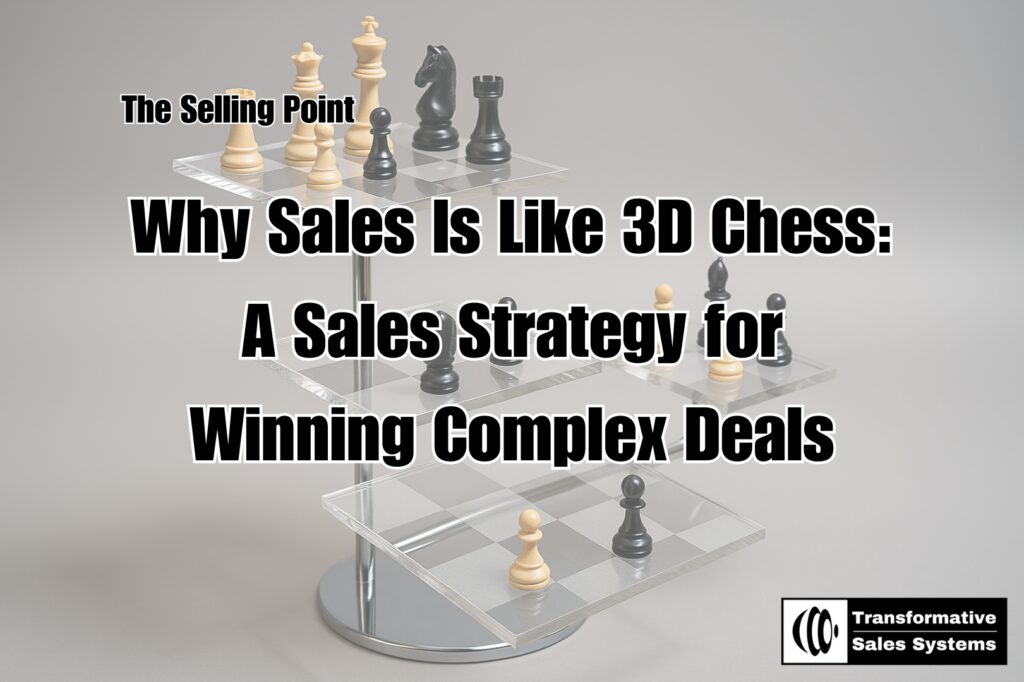
Most people treat sales like checkers: move fast, grab a few pieces, celebrate the easy wins. Reality checks that fantasy. Modern B2B sales lives on multiple levels at once. You’re navigating buyers with competing priorities, internal politics, and competitors who never stop probing. If you want consistent results, you need a 3D chess sales strategy that helps you see the whole field and plan several moves ahead.
What “3D Chess” Really Means in Sales
In Star Trek, 3D chess stacks several boards vertically. Moves on one board affect the others. That is sales in a nutshell. A pricing discussion with a manager affects the CFO’s view of ROI. A great discovery call with your champion changes how a skeptical stakeholder interprets your proposal. If you think in one dimension, you lose to someone who sees all three.
The Three Dimensions of a 3D Chess Sales Strategy
Level 1: Deals and Activities
This is the visible board. Calls, emails, discovery, demos, proposals, follow-up. Activity matters, but activity alone does not create momentum. The right sequence, the right message, and the right next step create momentum.
Level 2: Relationships and Influence
Titles do not buy. People do. You need a champion who believes, a blocker who stops resisting, and an executive who sees strategic value. Mapping the organization, understanding personal wins, and aligning to each person’s “why” is non-negotiable.
Level 3: Strategy and Process
This is where most teams fall down. Without a defined sales process, stage definitions, conversion expectations, and CRM discipline, the other two levels devolve into chaos. Strategy is how you qualify, how you progress, and how you forecast with accuracy. Process is how you do it every week.
Think Three Moves Ahead
Great reps and leaders always work backward from the win. If the deal must close in Q4, what must be true in Q3? What decision criteria will finance use? Which risks could stall the purchase and how do we surface them early? Anticipation is not guessing. It is a disciplined habit of scenario planning and proactive next steps that reduce uncertainty for the buyer and for you.
Quick prompts to use with your team:
-
“If we say yes to their discount request, what do we need from them in return?”
-
“If our champion left tomorrow, who would carry this over the finish line?”
-
“If a competitor undercuts us on price, where do we still win and how do we prove it?”
Balance Offense and Defense
Offense fills the pipeline. It is prospecting, referrals, partner motions, and targeted campaigns. Defense protects what you have already earned. It is de-risking deals, multi-threading accounts, tightening mutual action plans, and confronting objections before they surface at the final signature. Most teams over-index on one. The best teams schedule time for both every week and measure both with equal intensity.
Complexity Requires a System
Complexity is not a reason to panic. It is a reason to adopt structure. A 3D chess sales strategy becomes practical when you operationalize it:
-
Clear stage gates: advance only when specific buyer-verifiable outcomes occur.
-
Deal hygiene: every opportunity has a champion, a mutual plan, and an agreed next step on the calendar.
-
Pipeline math: know required activity, stage-by-stage conversion, and average deal cycle so you can coach gaps, not feelings.
-
Call planning and debriefs: before the meeting, define the desired outcome. After, document what changed on each level.
When you build these habits, the “stack of boards” stops feeling overwhelming. It becomes predictable.
Coaching the Game: What Leaders Must Do
Leaders who win do not just track numbers; they teach reps to see all three levels. In 1:1s, move past “what happened” and ask “what happens next and why.” In pipeline reviews, ask who cares, who blocks, and what proof you have that the customer is actually moving. Replace generic encouragement with specific commitments and time-bound next steps. Your job is to build decision clarity, not cheerlead ambiguity.
Where Fractional Sales Management Fits
Many SMBs know they need this system but lack bandwidth or in-house expertise to implement it. That is where Fractional Sales Management shines. We step in as experienced sales leadership to install the process, coach the team, and create accountable operating rhythms without the cost of a full-time executive.
A couple of quick snapshots from recent engagements:
-
B2B Media Company: After a year at under 70% of plan, we rebuilt the sales process, instituted rigorous pipeline cadence, and coached multi-threading. They reached their annual goal the following year with greater forecast accuracy.
-
B2B Manufacturing: After finishing 25% down, we reset ICP focus, added structured outbound, and installed deal hygiene. The team tracked to plan and stabilized revenue performance.
Different industries, same outcome: a system that turns complexity into clarity.
Implementation Roadmap You Can Start This Quarter
-
Define the Boards: Write down your stage definitions, required proof points, and the roles you must win with on a typical deal.
-
Mutual Action Plans: For every qualified opportunity, co-create a dated plan with your champion. Share it. Live by it.
-
Cadence: Weekly pipeline review, weekly 1:1s, and a monthly strategy session on stuck deals. Short, focused, consistent.
-
Enablement: Create a discovery guide, objection map, and competitive traps-and-counterplays. Keep them updated.
-
Scorecard: Track activity, stage conversions, cycle time, average deal size, and forecast accuracy. Coach the gaps.
Do these five and you will feel the gears mesh.
FAQs
What is a 3D chess sales strategy?
It is a structured approach that manages deals, relationships, and strategy at the same time, with clear stage gates and proactive scenario planning.
How does it help close complex deals?
By forcing multi-threading, clarifying next steps, and anticipating risks before they become end-of-quarter emergencies.
Is this overkill for smaller teams?
No. Smaller teams benefit the most because clarity and focus protect limited capacity and create consistent results.
The Bottom Line
Sales is not 2D anymore. It is 3D. If your team only plays the activities board, you will keep losing to competitors who manage the relationships and the strategy boards too. Build a 3D chess sales strategy, coach it every week, and the game becomes winnable.
Ready to upgrade how your team plays the game? Let’s talk about installing this system in your organization. Transformative Sales Systems brings the leadership, process, and accountability to help your team win across every board.
Transformative Sales Systems
812-924-7085
Schedule a 30 minute meeting: https://calendly.com/anthony-nicks/30min
Learn more about Fractional Sales Management at https://transformativesalessystems.com/services/
Read more about Fractional Sales Management: https://www.amazon.com/dp/B0FLWSXX5D