
If sales results feel inconsistent, forecasts are unreliable, or opportunities keep sitting in the pipeline without going anywhere, the problem may not be your market. It may not even be your salespeople. In many small and midsize businesses, the real issue is the sales process itself.
That is the hard truth.
A lot of companies think they have a sales process when what they really have is a collection of habits. One salesperson runs a solid discovery call. Another jumps straight to pricing. A third keeps deals hanging around for months with no real next step. That is not a sales process. That is improvisation.
A sales process audit helps you find the breakdowns. It shows you where deals stall, where qualification is weak, where your CRM is giving you bad signals, and where your team is relying on instinct instead of discipline. Done right, it gives you a path to better win rates, a cleaner pipeline, and a forecast you can actually trust.
Step 1: Map your current sales process
Before you improve anything, you need to understand what is actually happening today. Not what leadership assumes is happening. Not what your CRM stages suggest. What is really happening in the field.
Document the full path from first contact to closed business. Then compare that map against how each salesperson actually moves an opportunity. This is where the cracks usually show up fast.
You may find that one rep goes from discovery straight to proposal without really qualifying the opportunity. Another may leave deals sitting in follow-up for weeks with no scheduled meeting, no decision process, and no urgency. That kind of inconsistency creates a messy pipeline and makes coaching far harder than it should be.
If your process is not clearly documented, your team is probably making it up as they go.
Step 2: Review conversion rates by stage
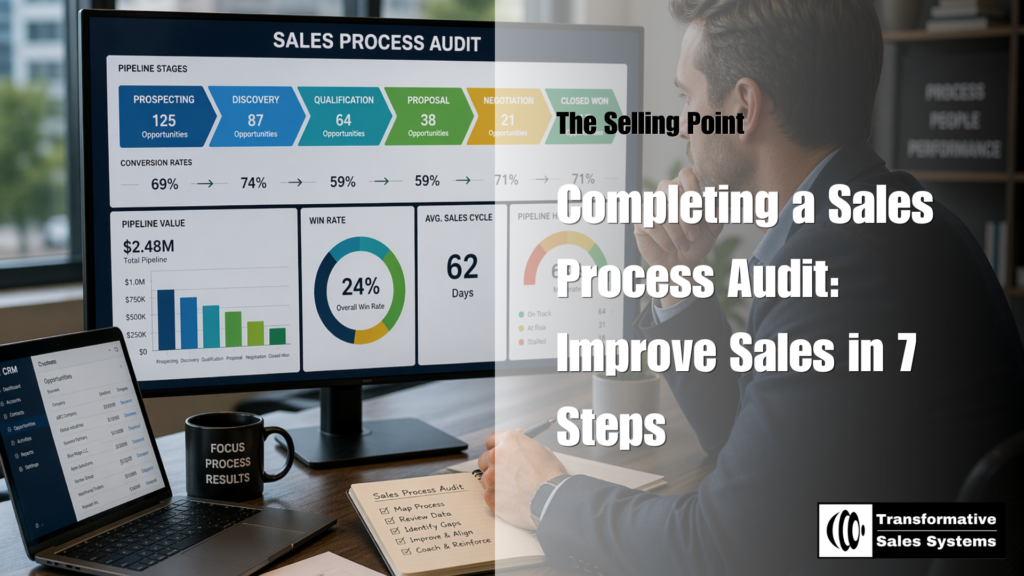
Once the process is mapped, look at your data. Review how opportunities convert from one stage to the next. You are looking for bottlenecks, inflated stages, and places where deals are moving forward without earning the right to move forward.
For example, if a high percentage of opportunities make it to proposal but only a small percentage close, that usually points to a qualification issue. It can also mean your team is quoting too early, talking to the wrong people, or failing to establish enough value before price shows up in the conversation.
Conversion rates cut through opinions. They show you where the process is leaking.
Step 3: Compare how top performers sell versus everyone else
Top performers often follow a better process even when they cannot fully explain it. Underperformers usually skip steps, rush deals, or rely too heavily on personality and persistence.
Talk to both groups.
Ask questions like:
How do you qualify an opportunity?
What has to be true before you move to the next stage?
How do you handle pricing pressure?
What triggers a proposal?
What does a real next step look like?
You are not just gathering opinions. You are looking for repeatable behaviors that can be standardized and coached across the team.
A lot of sales teams do not fail because people are lazy. They fail because people are inconsistent.
Step 4: Tighten your qualification criteria
Weak qualification burns time and clogs the pipeline with deals that were never real to begin with.
If your team is spending hours on demos, proposals, and rework for prospects who do not have budget, authority, urgency, or a clear need, the problem is not effort. The problem is process discipline.
Your qualification criteria should be clear enough that a salesperson can explain exactly why an opportunity deserves time and resources. This does not mean forcing everyone into a rigid script. It means defining the minimum information required before a deal advances.
For many businesses, that includes business pain, decision makers, timing, budget expectations, and the consequences of doing nothing. Whatever framework you use, it needs to fit your business and it needs to be enforced.
Step 5: Define exit criteria for every stage
This is one of the biggest gaps in most sales processes. The stages have names, but nobody really knows what those names mean.
Every stage in your sales process should have exit criteria. In plain English, what must be true before a deal moves forward?
A deal should not move from discovery to proposal because the salesperson feels good about it. It should move because specific milestones have been met. That may include confirmed need, identified stakeholders, budget range, decision process, timeline, and an agreed next step.
When exit criteria are vague, pipeline stages become subjective. That leads to inflated forecasts, poor coaching conversations, and end-of-month surprises nobody enjoys.
Clear stage definitions create accountability and make CRM reporting far more useful.
Step 6: Make sure your CRM reflects the real process
Your CRM should support the sales process, not fight against it. If your stages, required fields, and workflows do not match how you want your team to sell, the system becomes administrative noise instead of a management tool.
This is one of the most common mistakes I see. Companies say they want process discipline, but their CRM allows reps to skip critical fields, move deals without evidence, and leave records half complete. Then leadership wonders why the forecast is off.
If you want a tighter process, your CRM has to reinforce it. Required fields, stage definitions, reminders, and workflows should align with the way you expect opportunities to move. Your CRM should reflect reality, not hope.
Step 7: Reinforce the process through coaching and deal reviews
A documented sales process means very little if nobody coaches to it.
This is where weekly one-on-ones, pipeline reviews, and real deal coaching matter. Managers need to inspect how opportunities are moving and ask better questions. Not “How is that deal going?” but “What qualification criteria have been met?” “Why is this deal in this stage?” and “What specific next step is scheduled?”
That shift changes everything.
It turns the sales process from a document into an operating system. It creates accountability, improves judgment, and helps salespeople think more critically about deal quality. Over time, that leads to better forecasts, stronger execution, and more predictable revenue.
Why a sales process audit matters
A sales process audit is not about creating more paperwork. It is about creating clarity.
It helps you identify what is real, what is being skipped, and what needs to change. It helps your team stop confusing motion with progress. And it gives leadership a better way to coach, forecast, and improve performance.
If your sales pipeline feels full but results are inconsistent, there is a good chance your process needs attention.
That is where the real work begins.
Final thought
Sales problems do not fix themselves. Leadership does.
If your team is struggling with inconsistent execution, weak qualification, pipeline inflation, or CRM stages that do not reflect how deals actually move, a sales process audit is one of the most valuable places to start.
Transformative Sales Systems helps small and midsize businesses build sales processes that salespeople can follow, managers can coach, and leaders can trust.
FAQ’s
What is a healthy sales team turnover rate for an SMB?
Keep total turnover under 20% per year and regrettable exits under 10%.
Should we raise pay to keep people from leaving?
Pay must be competitive, but fixing broken systems matters more. Extra money only delays exits if fundamentals aren’t right.
How long should ramp be?
Tie it to your sales cycle. For most SMBs, target a first deal within 60 days and full quota by 120–180 days.
What’s the single biggest lever to cut turnover?
Manager quality. A strong manager reduces chaos, develops people, and protects the team.
Transformative Sales Systems
812-924-7085
Schedule a 30 minute meeting: https://calendly.com/anthony-nicks/30min
Learn more about Fractional Sales Management at https://transformativesalessystems.com/sales-leadership/
Read more about Fractional Sales Management: https://www.amazon.com/dp/B0FLWSXX5D