
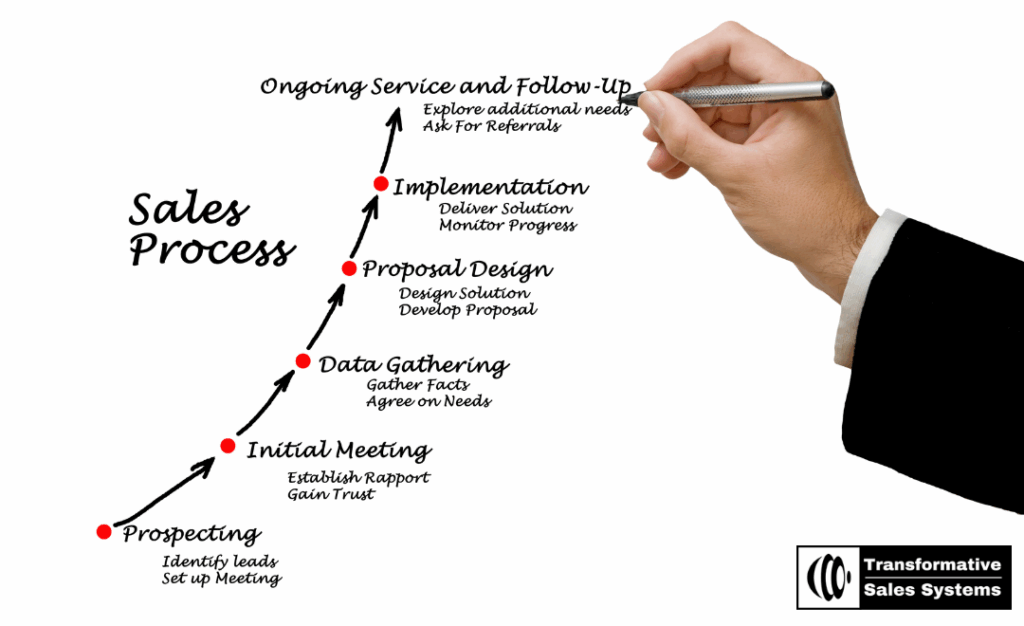
If you’ve ever wondered whether you really need a sales process, you’re not alone. A lot of owners and sales leaders assume a sales process is something “big companies” need, while smaller teams just need good people who can sell.
Here’s the truth. If your sales results feel inconsistent, your forecasts feel like guesses, your pipeline feels bloated with “maybe” deals, or price becomes your biggest objection, you do not have a “sales team problem.” You have a sales system problem.
A sales process is simply a defined path a buyer moves through, with clear expectations at each stage. It gives your team structure, gives you visibility, and gives your customers a better buying experience.
What a sales process actually is (and what it isn’t)
A sales process is the repeatable sequence of stages your team uses to move a prospect from first conversation to closed business. It includes what must be true before an opportunity moves forward.
A sales process is not:
- A script that makes salespeople sound robotic.
- A CRM pipeline that exists only for reporting.
- A methodology like Sandler, Challenger, or SPIN (those are how you sell, the process is where you are in the buyer’s journey).
- A sales funnel (that’s the flow of leads and conversion rates, not the step-by-step actions your team takes in a deal).
If you want consistent results, you need consistent execution. A documented process is how you get there.
Why you need a sales process, even if you have great salespeople
Great salespeople can succeed without a process, but the business still loses. When selling is dependent on individual style, you get “hero sales.” That’s fragile. It’s hard to scale, hard to forecast, and almost impossible to coach.
A process helps you:
- Increase consistency in performance across the team
- Shorten sales cycles by eliminating dead-end opportunities earlier
- Improve forecasting by defining stage criteria and buyer commitments
- Reduce price pressure by shifting from pitching to diagnosing and prioritizing value
- Coach and onboard faster because expectations are clear and measurable
And a big one. It makes success transferable. That’s how you build a sales engine, not a collection of personalities.
The 7 core steps of a sales process
Below is a simple, practical framework you can tailor to your business. Use it whether you’re selling services, manufacturing, construction, or B2B solutions.
Quick overview of the 7 steps
-
Prospecting: Identify and attract the right targets
-
Qualifying: Confirm fit and urgency before investing time
-
Discovery: Diagnose the problem and define success outcomes
-
Value building: Connect solutions to business impact
-
Proposal: Present a plan, not a PDF quote
-
Commitment: Confirm decision process, timing, and next steps
-
Close and onboarding: Win cleanly and hand off clearly
Step 1: Prospecting (find the right opportunities)
Prospecting is not just activity. It is targeted activity. Your process should define what a good prospect looks like, where they come from, and what the first touchpoint should accomplish.
At minimum, define:
- Ideal customer profile criteria (industry, size, geography, use case)
- Minimum deal size or margin thresholds
- Target personas (who you sell to and who influences)
- A short set of approved outreach messages and talking points
If your team is “busy” but pipeline quality is weak, this is usually where things start going sideways.
Step 2: Qualifying (earn the right to move forward)
Qualification is where you stop wasting time.
Most teams think they qualify, but they really just confirm interest. Real qualification answers: Is this real, is it solvable, and is it winnable?
Strong qualification checks:
- Problem: Is there a defined pain or goal?
- Impact: Does it matter enough to act?
- Timeline: Is there a deadline or trigger event?
- Stakeholders: Who is involved in the decision?
- Budget and investment: How will they fund this?
- Decision criteria: How will options be evaluated?
- Competition: Who else are they considering, and why?
Sample qualifying questions (use these as-is):
- “What happens if you do nothing for the next 90 days?”
- “Who besides you will weigh in on this decision?”
- “How will you evaluate options, and what matters most?”
- “What would make this a no-go, even if you like our solution?”
- “What timing are you aiming for, and what’s driving that?”
Step 3: Discovery (diagnose before you prescribe)
Discovery is the part most salespeople rush. They ask a few surface questions and then start pitching. That’s where deals turn into price comparisons.
Your process should define what must be uncovered in discovery:
- Current state: What’s happening today?
- Desired future state: What does “fixed” look like?
- Root cause: Why is this happening?
- Constraints: Time, resources, risk tolerance, internal politics
- Success metrics: What would they measure to confirm this worked?
Sample discovery questions that go deeper:
- “Walk me through how this works today, step-by-step.”
- “What’s the cost of this problem in time, money, or missed throughput?”
- “Where does this break down most often?”
- “If we solved this, what changes operationally or financially?”
- “What’s the internal resistance you expect we’ll run into?”
If discovery is done right, the buyer starts selling themselves on change. Your job is to guide it, document it, and align it to a decision.
Step 4: Build value (tie your solution to outcomes)
This is where you translate features into business impact. In B2B, buyers do not buy “features.” They buy risk reduction, margin improvement, cycle time reduction, revenue growth, or fewer headaches.
Your process should require:
- A clear problem statement in the buyer’s words
- A prioritized list of outcomes that matter most
- A simple ROI or impact narrative (even if it’s directional)
- A “why us” differentiation based on their decision criteria
If you cannot connect your offer to measurable outcomes, you will compete on price. Not because you’re expensive, but because you’re undifferentiated.
Step 5: Proposal (present a plan, not a PDF)
Proposals should not be emailed as a standalone document. A proposal should be presented in a meeting where you confirm alignment and drive next steps.
Your proposal meeting should include:
- Recap of their goals and current pain
- Agreed success outcomes and requirements
- Your recommended approach and scope
- Timeline and implementation expectations
- Investment and options (if appropriate)
- Decision process and next steps
If your proposal is a document that gets forwarded around internally, you have lost control of the sale.
Step 6: Test for commitment (confirm the decision process)
This is the stage where deals either move forward or quietly die.
Commitment is not, “Sounds good.” Commitment is clarity on how the buyer will decide and what happens next.
Minimum exit criteria for this stage:
- Decision makers identified (not guessed)
- Decision criteria confirmed
- Evaluation steps and timing mapped out
- Next meeting scheduled with the right people
- Risks and objections surfaced proactively
Commitment questions you should be asking:
- “Who needs to be involved before you can say yes?”
- “What concerns will they raise, and how should we address them?”
- “What are the top 3 factors that will determine the final decision?”
- “What is your internal process for approving this type of investment?”
- “If we check all the boxes, are you comfortable moving forward by [date]?”
Step 7: Close and onboarding (win cleanly and deliver)
Closing is not the end. It’s the handoff.
Your process should define:
- What must be signed and by whom
- What onboarding steps happen in the first 7–30 days
- Who owns customer communication at each stage
- How you confirm success metrics and implementation milestones
If onboarding is sloppy, churn and buyer remorse go up, and referrals go down.
Sales process in a CRM (this matters more than people think)
A CRM should not be a list of “stages that feel right.” It should be a reflection of your sales process with clear entrance and exit criteria.
If your CRM stages are vague, your pipeline data becomes fiction. That makes coaching harder and forecasting unreliable.
Practical CRM rules that work:
- Every stage has 2–5 required exit criteria
- You do not advance stages based on seller activity (like “sent email”)
- You advance stages based on buyer commitment (like “scheduled decision meeting”)
- Required fields match your qualification and discovery requirements
- Stale-deal rules exist (and are enforced)
Common signs you don’t have a real sales process
If any of these hit home, you need one:
- Salespeople describe their “process” differently
- Deals stall after proposals
- Price is the #1 objection
- You can’t explain why deals are lost beyond “they went dark”
- Forecast calls feel like guesswork
- New reps take too long to ramp
- Your pipeline is full but revenue misses happen anyway
Bottom line
If your team doesn’t follow a defined sales process, performance will stay inconsistent and forecasting will stay unreliable. A simple, well-defined process makes deals measurable, coaching easier, and growth repeatable.
How Fractional Sales Management helps (when you don’t have time to build this)
A lot of owners and CEOs know they need structure, but they don’t have the bandwidth to design it, implement it, and coach it into behavior.
That’s where Fractional Sales Management fits. The purpose is to bring experienced sales leadership into your business to build or refine the sales process, align it to your CRM, train the team, and create the accountability cadence that makes the process stick.
Frequently asked questions
What is a sales process?
A sales process is a repeatable set of stages and actions that guides prospects from first contact to closed business. It includes clear criteria for moving a deal forward so selling becomes consistent, measurable, and coachable.
Do small businesses really need a sales process?
Yes. Small and midsized businesses often need a sales process even more because performance swings are more painful. A process reduces randomness, improves forecasting, and helps owners stop relying on “hero reps.”
What is the difference between a sales process and a sales funnel?
A sales funnel measures volume and conversion rates across stages. A sales process defines the actions and requirements needed to move a buyer through those stages. Funnel is the math. Process is the method.
What is the difference between a sales process and a sales methodology?
A methodology is how you sell (your approach and conversation model). A process is where you are in the buyer journey and what must happen next. You can use many methodologies inside a single sales process.
Why do deals stall after the proposal stage?
Deals often stall because the decision process was never qualified. When stakeholders, evaluation criteria, and timing are unclear, the proposal becomes a comparison document and momentum disappears.
Should salespeople send proposals before understanding decision criteria?
No. Sending a proposal without understanding decision criteria increases comparison shopping, creates surprise objections, and delays decisions. You should confirm how the buyer will evaluate options before you build the proposal.
Why should proposals be presented in meetings instead of email?
Because email proposals get forwarded, misunderstood, and turned into price-only comparisons. A live proposal meeting allows you to confirm alignment, handle concerns, and drive a clear next step.
Transformative Sales Systems
812-924-7085
Schedule a 30 minute meeting: https://calendly.com/anthony-nicks/30min
Learn more about Fractional Sales Management at https://transformativesalessystems.com/sales-leadership/
Read more about Fractional Sales Management: https://www.amazon.com/dp/B0FLWSXX5D