
If you have ever looked at your pipeline and thought, “We should be fine,” only to watch the month close light, you are not alone. I hear some version of that all the time from CEOs and business owners in small and midsize businesses. The CRM stages says there is plenty in the pipeline. The sales team says there are opportunities moving. The forecast sounds reasonable. Then revenue misses anyway.
When that happens, most leaders start looking at the wrong things. They question the market. They question pricing. They question whether the team is working hard enough. Sometimes those are fair questions, but a lot of the time the real problem is much simpler.
The pipeline is lying.
Not because anyone is trying to deceive. Most of the time this is not intentional at all. The pipeline lies because deals are being moved forward based on activity, optimism, and polite buyer behavior instead of real sales qualification. The CRM starts showing conversations as if they were opportunities. And once that happens, the forecast gets shaky, coaching gets harder, and leadership starts making decisions off bad information.
The pipeline usually is not lying on purpose
This is the part that matters. In most SMB sales teams, pipeline inflation is not some grand act of manipulation. It is usually the result of human nature and weak stage discipline.
A salesperson has a good call, so the deal moves to the next stage. A prospect asks for a proposal, so now it feels serious. A buyer says they are interested, so it gets mentally counted before it ever earns the right to be counted. Everyone wants the deal to be real, especially when the pipeline needs help. Optimism starts doing the work that qualification should be doing.
That is how you end up with a CRM full of deals that look alive but are not actually moving toward a decision.
This is also why so many companies feel busy but not productive. The team is active. There are meetings. There are proposals. There is follow-up. But because the stages are not tied to proof, the pipeline becomes a storage unit for hope instead of a decision-making tool.
Activity is not the same as qualification
This is one of the most important distinctions in sales, and it gets missed all the time.
Activity is something the salesperson does. Qualification is something the buyer proves.
That sounds simple, but it changes everything once you start running the pipeline that way.
A discovery call is activity. A demo is activity. Sending a proposal is activity. Following up is activity. None of those things, by themselves, prove the opportunity is real.
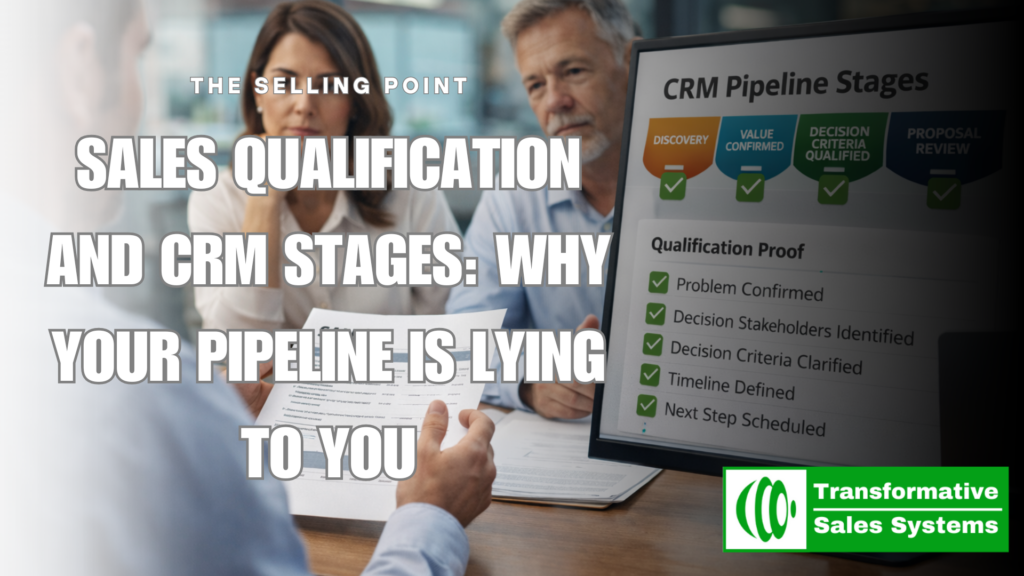
Qualification is different. Qualification means the buyer has given you evidence that this is a legitimate opportunity worth your time and attention. That evidence usually includes things like a clearly defined problem, a real business impact, known decision criteria, identified stakeholders, a decision timeline, and a mutually agreed next step.
When those elements are missing, you do not have a qualified deal. You have motion. And motion is not the same thing as progress.
That is where a lot of SMB pipelines get into trouble. The CRM stages reflect what the salesperson did, not what the buyer has proven. Once that happens, the pipeline starts overstating reality.
Why CRM stages should mean something
A healthy pipeline is not a list of conversations. It is a record of buyer progress. That means each stage in the CRM should stand for something concrete. A stage should not mean “we talked.” It should mean “the buyer proved this deal belongs here.”
For example, a discovery stage should not just mean the rep held a discovery call. It should mean discovery produced something useful and specific. The buyer confirmed a real problem. The impact of that problem was clarified. The timeline started to come into focus. Stakeholders began to surface. A meaningful next step was agreed to.
That is very different from just having a nice conversation.
The same logic applies all the way through the pipeline. Proposal stage should not mean “a quote was emailed.” It should mean the proposal supports an actual decision process, with the right people involved, the right criteria understood, and a review conversation scheduled.
If your stages do not mean those things, then your CRM is not helping you manage revenue. It is just giving names to hope.
Why salespeople resist stage discipline
When companies start tightening stage definitions, salespeople often push back. That reaction is normal. They feel like the pipeline is shrinking. Deals that once looked healthy suddenly do not qualify. Forecast numbers start getting smaller. It can feel like leadership is being negative or overly strict.
But that is not what is happening.
What is really happening is the truth is becoming visible.
The pipeline is not getting worse. It is getting more honest. And while that can feel uncomfortable in the short term, it is one of the healthiest things that can happen to a sales organization. A smaller, cleaner pipeline is far more valuable than a larger, inflated one. At least you can work with the truth.
This is one of the reasons owners and CEOs get frustrated with sales teams. They are often being handed forecasts that were built on optimism, not qualification. Then when deals slip, everyone acts surprised. But the surprise was baked in from the beginning because the stage discipline was weak.
What good pipeline review actually sounds like
A lot of sales meetings are too soft on pipeline review. Reps give a status update, everyone nods, and the deal stays where it is. That is not pipeline management. That is storytelling.
A real pipeline review sounds different. It is built around qualification.
Instead of asking, “How is this one looking?” leadership should be asking questions like:
- What problem did the buyer confirm?
- What is the impact of that problem?
- Who is involved in the decision?
- What are the decision criteria?
- What timeline have they committed to?
- What is the next scheduled step?
Those questions are not designed to trip anybody up. They are designed to separate real opportunities from wishful thinking. If the answers are vague, then the deal probably does not belong where it is sitting in the CRM.
And yes, sometimes that means moving it backward. That is not a loss. That is a correction. Corrections make the forecast stronger.
The CRM should be a coaching tool, not just a reporting tool
This is where a lot of companies miss the real value of a disciplined sales process. A properly managed CRM is not just there to report numbers upward. It should help leadership coach the team.
When stages are tied to qualification, patterns start becoming obvious. You can see where deals are really getting stuck. You can see where reps are struggling. You can see whether the issue is discovery, next steps, decision criteria, price pressure, or something else.
For example, if deals consistently stall after discovery, you may have a questioning problem. If proposals keep going dark, there is a good chance decision criteria were never qualified. If late-stage deals linger forever, next steps are probably weak or unscheduled.
That is useful. That gives you something to coach to. Now the CRM becomes part of your operating system instead of just a digital filing cabinet.
Why this matters so much to CEOs
For a CEO, the pipeline should create clarity. It should help answer big questions.
Can we trust this forecast? Where is the real risk? What should I pay attention to this month? Do we have enough quality opportunities, or just a lot of noise?
When the stages are weak, none of those questions can be answered with confidence. The pipeline may look full, but it is not dependable. That leads to bad decisions. Hiring decisions get delayed or rushed. Cash flow assumptions become shaky. Growth planning becomes more emotional than strategic.
This is why sales qualification and CRM stage discipline matter so much. They are not “sales things” only. They are business-management things. If your pipeline cannot be trusted, then a lot of the business decisions built on top of it cannot be trusted either.
Where leadership changes the outcome
This does not get fixed by telling the team to “update the CRM better.” It gets fixed by leadership defining what each stage actually means and enforcing those definitions consistently.
That means sales qualification standards have to be clear. Reps need to know what proof is required before a deal advances. Managers need to inspect that proof during deal reviews. And the organization needs to stop rewarding inflated pipelines just because they look comforting.
This is one of the reasons fractional sales management can make such a big difference for SMBs. Most companies do not need more CRM fields. They need leadership that installs discipline, coaches to the process, and keeps the pipeline honest week after week.
Without that, the CRM becomes a place where bad habits hide. With it, the CRM becomes a powerful tool for forecasting, coaching, and accountability.
Bottom line
If your pipeline looks strong but revenue keeps missing, there is a good chance the issue is not effort. It is not the market. It is not even necessarily the people.
It is probably stage discipline.
When CRM stages are based on activity instead of qualification, the pipeline starts lying. Deals move forward because conversations felt positive, not because buyers proved they were moving toward a real decision. That creates inflated forecasts, weak coaching, and frustrated leadership.
The fix is straightforward, even if it takes discipline to implement. Your CRM stages must represent proof of buyer progress, not salesperson activity. Once that happens, the pipeline gets smaller, cleaner, and much more useful.
And when the pipeline becomes honest, revenue becomes a whole lot easier to manage.
FAQ’s
What is the difference between sales activity and sales qualification?
Sales activity is what the salesperson does (calls, emails, outreach, meetings). Sales qualification is what the buyer has confirmed (problem, impact, urgency, decision process, and next step). Activity creates opportunity. Qualification determines whether the opportunity is real.
Why does a pipeline look full but still miss revenue goals?
Because volume is being mistaken for progress. Pipelines miss goals when deals are sitting in later stages without verified milestones, timelines, or decision ownership. The pipeline is “full,” but it’s full of unqualified or stalled opportunities.
What should CRM stages represent in a sales process?
CRM stages should represent verified buyer progress, not salesperson hope. Each stage needs clear entry and exit criteria tied to what the buyer has agreed to do next (stakeholders identified, decision criteria confirmed, proposal review meeting scheduled, etc.). If it’s not verified, it’s not a stage change.
How do sales qualification and CRM stages improve forecasting?
They improve forecasting by forcing reality into the pipeline. When stages are based on qualified milestones, the “probability” of a stage actually means something. That reduces late-stage deals that linger, exposes gaps earlier, and makes revenue projections far more reliable.
Why do salespeople resist stricter CRM stage discipline?
Because it removes comfort. Stricter discipline exposes weak discovery, unclear next steps, and “maybe” deals that should be disqualified or pushed back. It can also feel like micromanagement if the leader uses the CRM to police instead of coach.
How should a sales leader review pipeline stages?
Review stages by validating proof, not asking for opinions. Start with late-stage deals and require the salesperson to show the decision timeline, stakeholders, decision criteria, and the scheduled next step. If those aren’t present, move the deal back, reset the next step, or disqualify it.
Can a CRM be used as a coaching tool?
Yes, if it’s treated as a shared operating system instead of a reporting chore. A CRM becomes a coaching tool when leaders use it to diagnose where deals stall, improve discovery, tighten next steps, and build consistent behaviors across the team.
What is the fastest way to fix an inflated pipeline?
Lock down stage criteria and run a full pipeline reset. In one or two deal review sessions, force every opportunity to prove decision ownership, decision criteria, timeline, and a scheduled next step. Anything that can’t meet the standard gets pushed back to an earlier stage or closed out.
Transformative Sales Systems
812-924-7085
Schedule a 30 minute meeting: https://calendly.com/anthony-nicks/30min
Learn more about Fractional Sales Management at https://transformativesalessystems.com/sales-leadership/
Read more about Fractional Sales Management: https://www.amazon.com/dp/B0FLWSXX5D