Your Pipeline Problem Might Actually Be an ICP Problem
A lot of small and midsize businesses think they have a sales activity problem.
They think the team needs to make more calls, send more emails, attend more networking events, or load more leads into the CRM. Sometimes that is true. But not always. In many cases, the bigger issue is that the team is spending too much time chasing companies that were never a strong fit in the first place.
That is where Ideal Customer Profile, or ICP, comes in.
This is one of those concepts that gets thrown around a lot in sales and marketing conversations, but in practice, many businesses either do not define it clearly or they define it so broadly that it becomes useless. When that happens, the sales team ends up working a lot but not necessarily working in the right places. The pipeline looks active. Reps stay busy. Meetings happen. Quotes go out. Forecasts get built. Then the month ends and the revenue is not where it needs to be.
That is not always a lead generation problem. It is often an ICP problem.
What an Ideal Customer Profile actually is
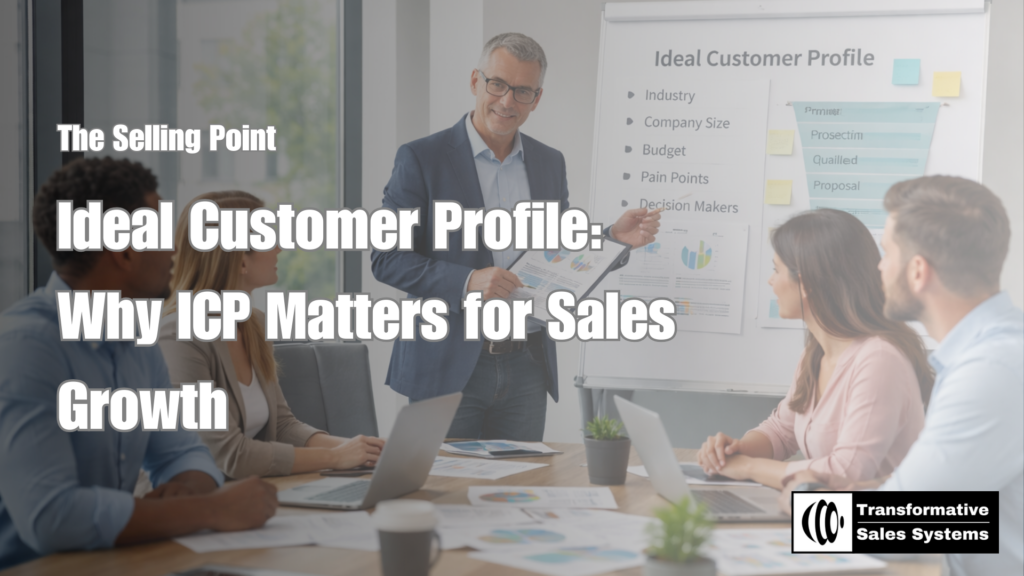
An Ideal Customer Profile is a clear definition of the type of company most likely to buy from you, benefit from your solution, and create the most value for your business over time.
That last part matters.
A true ICP is not just about who can technically buy. It is about who should buy. It is about identifying the kinds of customers that are the best fit for your offering, your sales motion, your delivery model, and your long-term profitability.
In plain English, your ICP helps answer questions like these:
- Which companies are most likely to move through our sales process successfully?
- Which customers tend to see the most value from what we do?
- Which deals are most likely to close at acceptable margins?
- Which customers are easiest for us to serve well after the sale?
- Which kinds of opportunities should our team prioritize and which ones should we avoid?
Without those answers, sales teams tend to fall into a dangerous pattern. They start treating any company with a pulse as a prospect.
That sounds like hustle, but it usually creates waste.
If everyone is a prospect, no one is
This is one of the most common problems I see in small and midsize businesses.
A company wants growth, so the natural instinct is to widen the net. The team starts going after more industries, more company sizes, more buyer types, more “possible opportunities,” and more random inbound leads. On the surface, it feels aggressive. It feels like the business is being proactive.
What is really happening is the organization is removing focus.
When focus disappears, the team starts prospecting into markets they do not understand, talking to buyers they are not equipped to sell to, and quoting work that does not align with the company’s strengths. They end up with a big fat pipeline full of deals that look real in a CRM report but were never likely to close.
Then leadership looks at the dashboard and says, “We have plenty of opportunities. Why are we missing the number?”
Because volume is not the same as fit.
A pipeline full of bad-fit opportunities is not a healthy pipeline. It is just a more organized version of wasted time.
Signs your business does not have a real ICP
A lot of companies say they know their ideal customer. Then when you dig in, the answer sounds something like this:
“We work with small to midsize businesses.”
Or:
“We can help any company that wants to grow.”
Or:
“Our customers are manufacturers, distributors, service companies, and really anyone who needs what we do.”
That is not an ICP. That is a lack of decision-making.
Here are some of the clearest signs that your business does not have a real Ideal Customer Profile.
Your pipeline looks full but revenue is inconsistent
This is one of the biggest warning signs. If your team always seems to have opportunities in motion but revenue still misses the target, there is a good chance too many of those opportunities are poor fit. They may have interest, but not urgency. They may like your team, but not have the budget. They may ask for proposals, but never had a real buying process in the first place.
Sales cycles drag out longer than they should
When you are selling to the right customers, deals still take work, but there is usually a pattern. There is a reason for the purchase, a recognizable pain point, and some level of urgency. When you are selling outside your ICP, deals often stall because the problem is not painful enough, the timing is weak, or the buyer is not actually equipped to act.
Price becomes the main objection too often
Not every price objection is an ICP issue, but many are. If your team keeps hearing that your pricing is too high, it may not mean you are overpriced. It may mean you are talking to companies that do not value your solution the way your best customers do.
Win rates are unpredictable
A weak ICP usually produces scattered performance. One rep closes a large deal in one segment, another chases a totally different kind of account, and a third is quoting everything that moves. Nothing is consistent enough to coach, measure, or scale.
Salespeople create their own version of the target market
When there is no clear ICP, every salesperson builds one on their own. One goes after familiar industries. One follows whoever responds to an email. One only pursues referrals. One chases large logos. One quotes small deals just to stay active. This creates chaos disguised as effort.
Customers who do buy are not always good customers after the sale
This is a big one. A deal is not automatically a good deal just because it closed. If the customer is hard to onboard, hard to serve, constantly pushes scope, drains internal resources, or produces poor margins, then you may be winning the wrong business.
A good ICP should improve not only who you sell to, but also the quality of the business you keep.
Why ICP matters to sales, not just marketing
Sometimes ICP gets stuck in the marketing department.
It becomes part of messaging exercises, campaign strategy, branding workshops, or website copy. There is nothing wrong with that, but if ICP stops there, the company misses the bigger opportunity.
Ideal Customer Profile is a sales tool.
In fact, it should be one of the most important sales tools in the business because it directly impacts how the team prioritizes time and how leadership drives performance.
A strong ICP improves prospecting because the team has a clearer target. It improves qualification because reps know what fit actually looks like. It improves messaging because the team can speak to relevant business pain instead of using generic value statements. It improves forecasting because leaders are evaluating deals against better-fit criteria. And it improves coaching because managers have a more objective basis for asking, “Should we even be pursuing this?”
When ICP is clear, sales gets sharper.
When ICP is vague, sales gets noisy.
What should be included in an Ideal Customer Profile
A useful ICP is not vague and it is not built from wishful thinking. It should include practical characteristics that help the sales team determine whether an account is worth pursuing.
That typically starts with firmographic basics such as industry, company size, revenue range, employee count, geography, or market segment. Those are important, but they are not enough on their own.
Two companies can be in the same industry, have similar revenue, and still be very different sales opportunities.
That is why a strong ICP should also include operational and commercial realities such as these:
- What business problems do these companies commonly face that we are well positioned to solve?
- What events or triggers make them more likely to buy now?
- What level of pain or urgency usually exists when a deal is real?
- What internal capabilities or gaps make our solution relevant?
- Who typically owns this problem internally?
- What kind of buying process do they tend to follow?
- What budget range or investment mindset is realistic?
- What makes them profitable for us beyond just the initial sale?
- What makes them likely to become long-term, successful customers?
In other words, your ICP should reflect not just who the company is, but how they behave, what they care about, and why they buy.
That is what makes it usable in actual selling.
ICP is not the same as a buyer persona
These two terms get mixed together all the time, but they are not the same.
Your Ideal Customer Profile defines the type of company you should be targeting.
Your buyer persona defines the type of person within that company that you may be selling to.
That distinction matters.
For example, your ICP might be a privately held manufacturer with $10 million to $50 million in revenue, limited sales leadership, an inconsistent pipeline, and a desire to grow without adding a full-time executive headcount.
Within that ICP, the buyer persona might be the CEO, owner, president, or VP responsible for revenue.
One is the organization. The other is the human being involved in the decision.
If you confuse the two, your sales process gets muddy. You may build messaging around a title without being clear on whether the company itself is worth targeting. Or you may identify a good-fit company but fail to understand the actual concerns of the person making the decision.
You need both. But ICP comes first, because it determines whether the account is even worth the team’s attention.
How to build an ICP from real data instead of opinions
This is where a lot of businesses get lazy.
They sit in a conference room and guess.
They say things like, “We want bigger customers,” or “We should probably go after healthcare,” or “I think construction is a good market for us.” None of that is automatically wrong, but it is not enough. Your ICP should not be built on hunches alone.
It should be built from evidence.
The best place to start is your current and past customer base. Look at your strongest customers and ask what they have in common. Then look at the deals you lost, the deals that stalled, and the customers that became difficult after the sale.
Patterns usually start to emerge pretty quickly.
Here are some of the things worth reviewing:
- Closed-won deals over the last 12 to 24 months
- Average deal size by segment
- Gross margin or profitability by customer type
- Sales cycle length by type of account
- Win rate by industry or category
- Retention and expansion potential
- Ease of implementation or service delivery
- Common pain points among successful customers
- Common reasons lost deals were lost
- Frequency of discounting by segment
- Internal strain caused by certain types of customers
This is one of the reasons sales leadership matters so much. Someone needs to look across the data and separate activity from actual commercial value.
A good ICP is not built by asking, “Who could we sell to?”
It is built by asking, “Where have we consistently created value, won business, made money, and delivered successfully?”
That is a much smarter question.
Your best customers should teach you where to focus
One of the most practical ways to build an ICP is to study your best customers as if they are clues.
- What do they look like?
- What problem were they trying to solve when they bought?
- Why did your solution make sense for them?
- Why did they move when they did?
- How long did it take to close?
- How painful was the implementation?
- Did they become profitable?
- Would you want ten more like them?
That last question is powerful because it cuts through a lot of BS.
There are customers who buy from you that you do not actually want more of. Maybe they were difficult. Maybe they pushed pricing too hard. Maybe they consumed too much support time. Maybe the work was outside your sweet spot. Maybe they were one-off wins that looked good at the time but created more drag than momentum.
Your ICP should not be built around whoever happened to buy from you. It should be built around the customers you most want to replicate.
The role of disqualifying in a strong ICP
A lot of companies only think about ICP in positive terms. They define who they want. That is important, but it is only half of the exercise.
You also need to define who is not a fit.
This is where many businesses struggle because saying no feels risky. Leadership worries about leaving money on the table. Salespeople worry about having fewer deals to chase. So the company keeps the definition broad and leaves the door open to almost anything.
That creates a downstream mess.
A mature sales organization understands that disqualifying is healthy. In fact, it is necessary.
Your non-ICP list may include companies that are too small to justify your sales effort, too complex for your delivery model, too price-driven to value your solution, too misaligned operationally, or too unlikely to make a decision in a reasonable timeframe.
That does not mean those companies are bad businesses. It just means they are not good targets for you right now.
That level of clarity protects your team’s time. It also protects morale. Salespeople burn out when they are asked to pursue low-probability opportunities and then get judged for not closing them.
How sales leaders should use ICP in the real world
An ICP document that sits in a shared folder and never gets used is worthless.
This is where leadership has to operationalize it.
First, ICP should directly influence prospecting strategy. The team should know which types of accounts belong on target lists and which do not. That affects outbound activity, territory planning, referral strategy, and how inbound leads are triaged.
Second, ICP should be built into qualification. Reps should be able to explain why an account fits before the opportunity is allowed to move too far into the pipeline. That can happen through discovery criteria, stage-entry requirements, or simple qualification checkpoints in the CRM.
Third, ICP should show up in pipeline review conversations. Leaders should not just ask about close date, proposal status, or next step. They should also ask, “How does this opportunity match our Ideal Customer Profile?” If the answer is weak or hand-wavy, that matters.
Fourth, ICP should shape coaching. If a rep keeps filling the pipeline with poor-fit deals, that is a coaching issue. If the team does not understand how to identify buying triggers in target accounts, that is a coaching issue too.
Fifth, ICP should influence forecasting. Deals that match the ICP closely are generally more believable forecast opportunities than deals that do not. That does not guarantee a close, but it does improve judgment.
In other words, ICP should not just live in strategy. It should live in execution.
Why many SMBs avoid doing this work
There are a few reasons businesses avoid getting serious about ICP.
One is fear. Narrowing the target market feels like shrinking opportunity. In reality, it usually improves effectiveness. But emotionally, it can feel like saying no to possible revenue.
Another is lack of discipline. Building a meaningful ICP takes work. It requires data review, tough conversations, and a willingness to challenge assumptions. A lot of companies would rather keep selling broadly and hope volume solves the problem.
Another is owner bias. In founder-led and owner-led businesses, it is common for the organization to chase whatever the owner thinks looks promising. Sometimes that instinct is useful. Sometimes it leads the team into markets where the company does not have a repeatable advantage.
And finally, some companies simply have not had sales leadership strong enough to force the conversation. Without someone accountable for pipeline quality, the path of least resistance is to let salespeople pursue whatever feels active.
That is how businesses end up confusing motion with progress.
Common mistakes companies make with ICP
There are several mistakes that show up repeatedly.
The first is making the ICP too broad. If your description could apply to thousands of very different businesses with very different buying behaviors, it is probably too generic.
The second is relying only on demographics or firmographics. Industry and company size matter, but they do not tell the whole story. Two similarly sized companies can have very different urgency, internal politics, budgets, and appetite for change.
The third is building the ICP based on aspiration instead of evidence. A business says, “We want enterprise clients,” even though its strongest results have come from mid-market companies. That kind of thinking can push the team away from the segment where it actually wins.
The fourth is failing to include disqualifiers. If there is no definition of bad fit, the sales team will continue to justify weak opportunities.
The fifth is never revisiting the ICP. Markets change. Your capabilities change. Your pricing changes. Your strategic direction changes. An ICP should not shift every month, but it should be reviewed periodically to make sure it still reflects reality.
The sixth is not connecting ICP to process. If it does not show up in prospecting, qualification, pipeline review, forecasting, and coaching, it will not change performance.
ICP should improve more than marketing efficiency
A lot of businesses think the main benefit of ICP is better messaging or more targeted campaigns.
Those are real benefits, but they are only part of the picture.
- A good ICP should improve sales productivity because reps stop wasting time on weak-fit accounts.
- It should improve forecast accuracy because pipeline quality goes up.
- It should improve close rates because the team is pursuing buyers with more relevant pain and stronger fit.
- It should improve margins because the business stops forcing bad deals through the system.
- It should improve customer experience because the company is serving customers it is actually equipped to help.
- And it should improve leadership decision-making because managers and owners can evaluate growth strategies through a clearer lens.
That is why this is not just a marketing exercise. This is a business discipline.
Fractional Sales Management can help turn ICP into action
This is one of the areas where Fractional Sales Management can have a real impact, especially in small and midsize businesses.
A lot of SMBs do not have anyone in the company whose job is to step back, look at the pipeline objectively, review win-loss patterns, evaluate fit, and align the sales process around what the business actually does best. The owner is busy. The salespeople are focused on their own deals. Marketing may be generating leads without enough feedback from the field. Everyone is moving, but no one is truly owning the quality of the target market.
That is a problem.
A strong sales leader can help the business define its ICP using real data, challenge assumptions about the market, identify the characteristics of the best customers, and create clear standards for qualification. More importantly, that leader can embed those standards into day-to-day sales management so the concept actually changes behavior.
That is what matters.
Because the goal is not to create a prettier strategy deck. The goal is to help the team spend more time on the right prospects, move better opportunities through the pipeline, improve win rates, and build a healthier revenue engine.
That is the work.
Bottom line
If your team is staying busy but revenue is still inconsistent, do not assume the answer is simply more activity. Take a harder look at who the team is actually spending time on.
You may not have a prospecting problem. You may not even have a closing problem. You may have a targeting problem.
When your Ideal Customer Profile is unclear, everything downstream gets harder. Prospecting gets noisy. Qualification gets loose. Pipelines get inflated. Forecasts get shaky. Coaching gets reactive. Revenue becomes harder to predict.
But when your ICP is clear and used correctly, sales gets more focused, more efficient, and more effective.
Not because the team is working more.
Because the team is finally working in the right places.
If your sales team is chasing too many low-probability opportunities, filling the pipeline with poor-fit deals, or struggling to turn activity into revenue, it may be time to define the market you should actually be serving and build your sales process around it.
That is how you stop confusing busyness with progress.
That is how you create a sales engine that can actually scale.
FAQ’s
What is an Ideal Customer Profile in sales?
An Ideal Customer Profile, or ICP, is a clear definition of the type of company most likely to buy from you, benefit from your solution, and become a profitable long-term customer. It helps a sales team focus on the right accounts instead of treating every possible lead as a good opportunity.
Is an ICP only for marketing teams?
No. Marketing may use ICP for targeting and messaging, but it is just as important for sales. A strong ICP helps salespeople prospect more effectively, qualify better opportunities, improve pipeline quality, and forecast with more accuracy.
What is the difference between an ICP and a buyer persona?
An ICP defines the type of company you should be targeting. A buyer persona defines the type of person within that company you may be selling to. The ICP tells you which accounts fit. The buyer persona helps you understand who inside those accounts is involved in the buying decision.
Why does a full pipeline still miss revenue goals?
Because a full pipeline does not always mean a healthy pipeline. Many businesses have plenty of opportunities in the CRM, but too many of those deals are a poor fit, have weak urgency, lack budget, or are unlikely to close. That is often a sign of an ICP problem, not just a sales activity problem.
How does an Ideal Customer Profile improve sales performance?
A good ICP improves sales performance by helping the team focus on better-fit accounts, qualify more effectively, reduce wasted time, improve win rates, and strengthen forecasting. It creates more focus throughout the sales process.
What should be included in an Ideal Customer Profile?
A useful ICP should include more than industry and company size. It should also consider business pain points, buying triggers, urgency, budget reality, decision-making structure, profitability, ease of service, and the types of customers most likely to succeed with your solution.
How do you build an ICP for a small or midsize business?
The best way is to study your current and past customers. Look at which customers closed faster, generated better margins, were easier to serve, stayed longer, and saw strong results from your solution. Then compare that to the deals you lost or the customers who created friction. Patterns usually emerge quickly.
Can an ICP help improve forecasting?
Yes. When sales leaders understand which deals closely match the Ideal Customer Profile, they can make better judgments about which opportunities are truly forecastable. Better-fit deals are not guaranteed to close, but they are usually more credible than weak-fit opportunities.
How often should a company review its ICP?
Your ICP should not change constantly, but it should be reviewed periodically. If your market changes, your capabilities evolve, your pricing shifts, or your growth strategy changes, your Ideal Customer Profile should be revisited to make sure it still reflects reality.
What happens when a sales team does not have a clear ICP?
When there is no clear ICP, salespeople often chase too many weak-fit opportunities, qualification becomes inconsistent, pipelines get inflated, forecasts become less reliable, and coaching becomes more reactive. The team stays busy, but revenue results remain uneven.
Should a company define who is not a fit?
Yes. A strong ICP should include both fit and non-fit criteria. Defining who is not a good target helps protect the team’s time, improves pipeline quality, and prevents the business from chasing deals that are unlikely to close or difficult to serve profitably.
How can Fractional Sales Management help with ICP?
Fractional Sales Management can help a business define its Ideal Customer Profile using real sales data, align prospecting and qualification around better-fit opportunities, and embed ICP standards into pipeline reviews, coaching, and forecasting. That turns ICP from a theory into a practical sales tool.
Transformative Sales Systems
812-924-7085
Schedule a 30 minute meeting: https://calendly.com/anthony-nicks/30min
Learn more about Fractional Sales Management at https://transformativesalessystems.com/sales-leadership/
Read more about Fractional Sales Management: https://www.amazon.com/dp/B0FLWSXX5D