
After Onboarding: Build a Sales Management Cadence That Improves Performance
Completing a 90-day onboarding plan does not remove the need for sales management. It changes the job from establishing readiness to developing consistent performance.
A company can recruit carefully, use assessments, conduct structured interviews, and build a strong onboarding plan. The new salesperson can learn the business, demonstrate the sales process, enter opportunities correctly in the CRM, and begin creating qualified pipeline. Then Day 91 arrives, and the management structure quietly disappears.
The manager assumes the salesperson now knows what to do. One-on-one meetings become less frequent. Pipeline review turns into a hurried status report. Coaching happens only when a deal is in trouble. The salesperson stays busy, but the connection between daily behavior, pipeline movement, and revenue begins to weaken.
That is not a salesperson becoming independent. It is a management system becoming inconsistent.
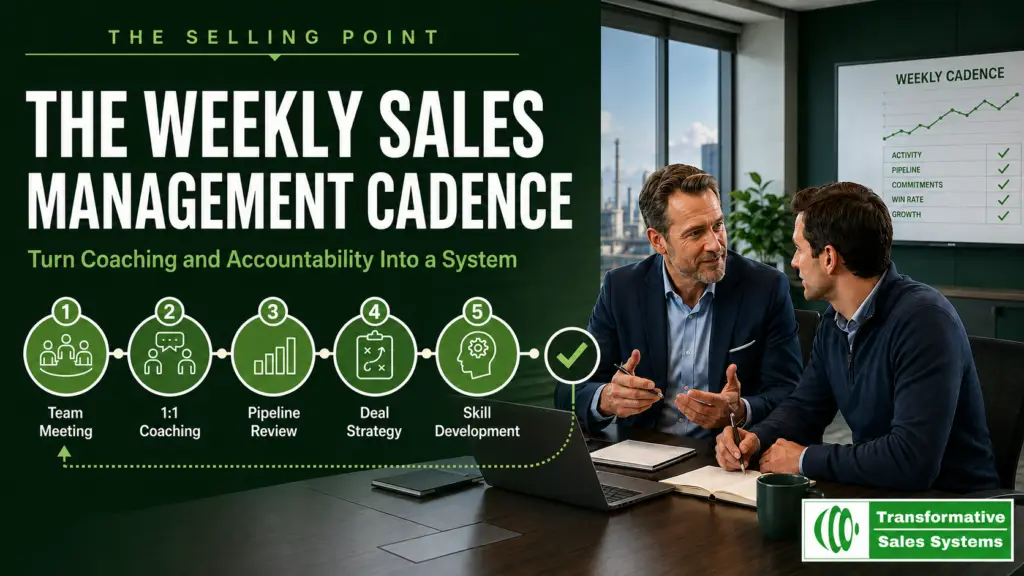
Onboarding should lead into a defined sales management cadence – a repeatable rhythm of team alignment, individual coaching, pipeline inspection, deal strategy, skill development, and accountability. Without that rhythm, even talented salespeople drift toward familiar habits, reactive work, and whatever opportunity is making the most noise that week.
Onboarding Is the Starting Line, Not the Finish Line
A structured onboarding process should prepare a salesperson to perform the core responsibilities of the role with growing independence. It should not create the expectation that the person will never need coaching, feedback, or inspection again. Sales is too dynamic for that.
Customers change. Competitors adjust. Products evolve. Pricing pressure appears. New stakeholders enter deals. A salesperson who was strong in discovery can begin rushing conversations when the pipeline gets thin. A disciplined prospector can stop creating new opportunities when two large deals appear close to signing. An experienced account manager can become overly comfortable with long-standing relationships and miss expansion risk.
These are not always character problems. They are normal forms of performance drift. The purpose of a sales management cadence is to identify that drift early, coach it directly, and keep the salesperson connected to the company’s standards before a small behavior becomes a quarterly revenue problem.
Why Sales Performance Drifts After Onboarding
Most salespeople do not wake up and decide to ignore the process. Drift happens gradually because immediate demands begin to outrank important disciplines. A customer needs a quote. An internal issue consumes half a day. A proposal must be revised. A large opportunity feels promising. Prospecting, pre-call planning, CRM updates, and post-call debriefing are pushed aside because they do not feel urgent in the moment.
Weak management systems allow that tradeoff to repeat without consequence. The company discovers the problem later, when pipeline is thin, opportunities have aged, forecasts miss, or the salesperson cannot explain why an important deal stopped moving.
Several common management habits make the problem worse.
- The weekly meeting tries to cover announcements, activity, pipeline, coaching, forecasting, and problem-solving in one hour.
- The manager reviews outcomes but does not inspect the behaviors and decisions that produced them.
- Coaching is reserved for struggling salespeople, which causes the entire team to treat coaching as punishment.
- The CRM is used to collect reports for leadership instead of creating evidence for better sales decisions.
- The manager steps into important deals and takes control rather than helping the salesperson improve.
- Accountability changes depending on how busy the manager is or how close the company is to missing the number.
None of these practices produces a dependable improvement loop. They create bursts of management activity followed by long periods of individual improvisation.
A Sales Management Cadence Is More Than One Weekly Meeting
The phrase sales management cadence is sometimes reduced to ‘we meet every Monday.’ A recurring meeting is useful, but cadence means more than recurrence. It means each management activity has a defined purpose, frequency, input, output, and owner.
A team meeting should not become an individual performance review conducted in front of everyone. A pipeline review should not become skills training for every possible weakness. A one-on-one should not be consumed by reading the CRM aloud. A deal strategy conversation should not become a manager taking over the opportunity.
When every conversation is forced into the same meeting, none of the work receives enough attention. A useful sales management cadence separates the jobs so each one can produce a clear result.
| Operating principle: Separate the meetings by purpose. Connect them through shared evidence, standards, and follow-through. |
The Six Parts of an Effective Weekly Sales Management Cadence
1. Team Sales Meeting: Align the Team
The team sales meeting should establish shared direction. It is the right place to review important company updates, recognize wins, reinforce one sales standard, examine a team-level trend, and resolve issues that affect more than one salesperson.
It is not the right place to interrogate every opportunity or publicly coach an individual through a sensitive performance issue. Keep the meeting focused on what the group needs to understand, decide, or improve together. A well-run team meeting should end with clear commitments, not a collection of general reminders.
2. Individual One-on-One: Develop the Salesperson
The individual one-on-one is the center of the coaching relationship. It should address the salesperson’s commitments, obstacles, priorities, development focus, and ownership of results. The conversation should be specific enough to change what the salesperson does next.
A useful one-on-one is not simply, ‘How are things going?’ The manager should arrive with evidence and the salesperson should arrive prepared to discuss what was attempted, what happened, what was learned, and what support is needed. The manager’s job is to ask questions that improve judgment, not to provide an answer before the salesperson has done the thinking.
For most SMB sales roles, a protected 30- to 45-minute weekly conversation is a reasonable starting point. Newer or struggling salespeople may require more frequent contact. Experienced high performers may need a different emphasis, but they should not be left without coaching simply because they are producing.
3. Pipeline Review: Establish What Is True
Pipeline review is an inspection process. The purpose is to determine which opportunities are real, what evidence supports the current stage, what buyer commitment exists, what risk is present, and what must happen next. It should improve qualification and forecast judgment, not merely produce a more polished report.
The CRM should provide the starting evidence: stage, value, age, activity history, stakeholders, decision criteria, timeline, and scheduled next step. The manager should test what is known and what is assumed. If the opportunity cannot meet the stage criteria, the answer is not to protect the forecast. The answer is to move it back, establish the missing evidence, or close it out.
Pipeline review is related to coaching, but it should not consume all coaching time. Its primary output is a more truthful pipeline and a clear set of opportunity actions.
4. Deal Strategy: Improve the Next Customer Decision
Deal strategy goes deeper than pipeline inspection. It focuses on selected opportunities where thoughtful preparation can change the outcome. The salesperson and manager should examine the customer’s business problem, decision process, stakeholders, competition, value, risk, and next conversation.
This is where pre-call planning and deal debriefing become powerful coaching tools. Before the meeting, the salesperson clarifies what must be learned, tested, and accomplished. Afterward, the salesperson separates facts from impressions and determines whether the opportunity became stronger, weaker, or simply different.
The manager should resist the urge to become the hero. If every important deal requires the manager to lead the call, write the message, or negotiate the terms, the company may win an occasional deal while failing to develop the salesperson.
5. Skill Development: Practice Before the Stakes Are High
Real deals create valuable coaching opportunities, but the company should not use customers as the only practice environment. Role-play, call review, message critique, and short skill drills allow the salesperson to improve discovery, qualification, objection handling, value communication, negotiation, and closing language before the next high-stakes conversation.
Skill development works best when it is narrow and repeated. Choose one behavior, define what good looks like, practice it, observe it in the field, and revisit it. A monthly two-hour training session followed by no reinforcement will not outperform short practice connected to live work.
6. Scorecard and Accountability: Close the Loop
Accountability begins with clarity. The salesperson should know which activities, behaviors, pipeline measures, and outcomes matter for the role. The scorecard should identify a small number of indicators that management can review consistently, not a long list of numbers that no one uses to make decisions.
The point is not to punish someone for every missed measure. The point is to notice patterns, discuss causes, agree on corrective action, and follow through. A number without a conversation is reporting. A conversation without a commitment is advice. Accountability requires both.
Build the Rhythm Around the Work, Not the Calendar
There is no single schedule that fits every sales organization. A three-person industrial sales team with long-cycle engineered opportunities should not copy the meeting structure of a 40-person transactional sales organization. The sales management cadence must reflect the size of the team, the complexity of the sale, the maturity of the salespeople, and the amount of customer activity available to inspect.
What matters is that the essential work occurs at a predictable frequency. A practical starting rhythm might include a weekly team meeting, weekly individual coaching, a separate weekly or biweekly pipeline review, pre-call and post-call coaching for selected opportunities, and a monthly skill-development focus. Leadership can adjust the duration and sequence, but removing one component usually creates a blind spot.
Protect the cadence on the calendar. If coaching is the first meeting cancelled whenever a customer issue appears, the company is communicating that development is optional. Customer needs will always be urgent. That is exactly why the management system must be deliberate.
The business case for consistency is not theoretical. Salesforce cites research indicating that effective coaching can improve sales performance, and a 2026 survey of sales professionals found a strong association between weekly coaching and quota attainment. The survey also reported that 41% of salespeople were rarely or never coached. The exact numbers will vary by company, but the operating lesson is hard to ignore: performance development cannot depend on when a manager happens to find time. Salesforce | MySalesCoach 2026 research
Coach from Evidence, Not Anecdote
Good coaching requires something specific to examine. General impressions such as ‘you need to be more aggressive,’ ‘follow up more,’ or ‘ask better questions’ do not tell a salesperson what to change. They create pressure without direction.
Evidence may come from a call plan, meeting recording, CRM notes, email sequence, proposal, pipeline movement, conversion rate, loss reason, or the salesperson’s own debrief. The manager should use the evidence to identify the point where the result began to weaken.
Was the wrong customer targeted? Did discovery stay at the surface? Was the business impact never quantified? Did the salesperson accept a vague next step? Was the decision process assumed? Did internal follow-through create delay? The answer determines what should be coached.
The CRM becomes valuable when it supports these questions. It becomes destructive when it is used only to police data entry or manufacture confidence for a forecast meeting. Evidence should create better judgment, not administrative theater.
Manage Leading Indicators Before Revenue Makes the Problem Obvious
Revenue matters, but revenue arrives after a series of decisions and behaviors. By the time the number is missed, the management opportunity may be weeks or months old. A useful sales management cadence examines the earlier signals.
Leading indicators may include target-account activity, quality conversations, discovery depth, conversion between stages, next-step discipline, opportunity age, pipeline coverage, proposal activity, forecast accuracy, account-expansion conversations, and the completion of agreed coaching actions. The correct mix depends on the role and sales cycle.
These measures should not become activity for activity’s sake. A salesperson can produce a large number of calls, emails, meetings, and CRM entries without creating meaningful buyer progress. The manager must connect activity to quality, quality to opportunity movement, and opportunity movement to revenue.
| Management test: Can the manager explain which behavior is limiting performance, what evidence supports that diagnosis, and what the salesperson is expected to do differently this week? |
Coach One High-Impact Behavior at a Time
Managers often overwhelm salespeople by delivering every observation at once. After a call, they may critique the opening, questioning, listening, technical explanation, presentation flow, objection response, pricing discussion, next step, and follow-up email. All of the feedback may be accurate, but very little of it will be applied.
Effective coaching prioritizes. Identify the behavior creating the largest constraint. Agree on what better execution looks like. Practice it. Watch for it in the next live situation. Then inspect whether the behavior changed and whether the result improved.
Gallup’s guidance on effective feedback reinforces this principle: feedback should be focused, tied to discernible behavior, and oriented toward future improvement. That makes the conversation more useful and gives the salesperson something within their control to change. Gallup
Coaching Is Not Micromanagement
Salespeople often resist management when they have experienced random inspection, public criticism, moving expectations, or managers who take over deals. That resistance should not be confused with a legitimate objection to structure.
Micromanagement controls activity without building judgment. Coaching establishes standards, examines evidence, asks questions, provides feedback, and expects ownership. The goal is not to make the salesperson dependent on the manager. The goal is to make the salesperson more capable of preparing, deciding, executing, and learning independently. Sales Coaching
The best test is simple: after several months of coaching, is the salesperson making better decisions without waiting for the manager? If not, the manager may be solving problems instead of developing capability.
Know When the Problem Is No Longer a Coaching Problem
A strong sales management cadence gives people a fair opportunity to improve. It also prevents coaching from becoming an excuse to avoid a difficult performance decision.
If expectations are clear, tools are available, the manager is coaching consistently, and the salesperson repeatedly avoids agreed activity, rejects feedback, ignores the process, fails to follow through, or cannot demonstrate the required competencies, the issue may not be a lack of coaching. It may be a role fit, commitment, will, or accountability problem.
Management should document the gap, define the required change, establish a reasonable deadline, provide the promised support, and inspect the evidence. If the behavior does not change, extending the timeline without a new reason does not help the salesperson or the company.
What the CEO or Owner Should Expect
The CEO does not need to attend every sales meeting or coach every opportunity. The CEO should expect the sales leader to operate a visible management system.
That system should show when the team meets, when individual coaching occurs, how pipeline is inspected, which skills are being developed, what the scorecard measures, what commitments were made, and whether those commitments were completed. Leadership should also be able to see whether performance problems are being diagnosed early or merely explained after the revenue miss.
The CEO should be careful not to undermine the cadence by inserting last-minute priorities, changing measures every week, or bypassing the sales manager to direct individual salespeople. A management system cannot create accountability if leadership repeatedly makes the system optional.
Most importantly, the CEO should expect evidence that the team is getting better. Meetings alone are not evidence. Improvement should appear in behavior, pipeline quality, conversion, forecast judgment, customer conversations, and ultimately revenue.
How to Install the Sales Management Cadence
Do not begin by adding more meetings. Begin by identifying the management work that is currently missing, duplicated, or mixed together.
- Define the purpose and expected output of each meeting or coaching activity.
- Separate team alignment, individual development, pipeline inspection, and deal strategy.
- Select the CRM evidence and scorecard measures required for each conversation.
- Place the cadence on the calendar and protect it for at least one full quarter.
- Document commitments, owners, and due dates so follow-through can be inspected.
- Review the system monthly and remove anything that consumes time without improving decisions or execution.
Start with discipline, then improve the design. The first version will not be perfect. What matters is that the company stops depending on memory, urgency, and the manager’s available time to determine whether salespeople receive leadership.
The Management System After Day 90 Determines What Happens Next
Recruiting selects the salesperson. Onboarding prepares the person to perform. The sales management cadence determines whether that performance improves, stalls, or quietly drifts backward.
The goal is not to fill the calendar with meetings. The goal is to create a weekly operating rhythm that produces clarity, truth, learning, and follow-through. Each component should do a different job, and together they should connect daily selling behavior to qualified pipeline and predictable revenue.
If your company has completed onboarding but still manages sales through occasional check-ins, emergency deal reviews, and month-end pressure, the next problem is not another training program. It is the absence of a management system.
Build the cadence. Protect it. Coach from evidence. Hold people to clear commitments. That is how a capable salesperson becomes a consistently productive one.
Frequently Asked Questions About Sales Management Cadence
What is a sales management cadence?
A sales management cadence is the repeatable rhythm a sales leader uses to align the team, coach individuals, inspect pipeline, improve deal strategy, develop skills, and reinforce accountability. Each activity should have a defined purpose, frequency, input, and expected output.
How often should a sales manager coach each salesperson?
Weekly individual coaching is a practical starting point for most small and midsize B2B sales teams. Newer or struggling salespeople may require more frequent contact. The quality and consistency of coaching matter more than simply scheduling a long monthly meeting.
Should pipeline review and sales coaching be separate?
Yes. Pipeline review primarily determines which opportunities are real, what evidence supports their stage, and what actions are required. Coaching develops the salesperson’s judgment and behavior. The conversations can inform one another, but pipeline inspection should not consume all development time.
What should happen during a sales one-on-one meeting?
The manager and salesperson should review commitments, priorities, obstacles, development goals, recent evidence, and the specific behavior that needs improvement. The meeting should end with a small number of clear actions, owners, and deadlines.
How can sales coaching avoid becoming micromanagement?
Use clear standards and observable evidence, ask questions before giving answers, focus on behaviors the salesperson can control, and require the salesperson to own the next action. The objective is stronger independent judgment, not greater dependence on the manager.
How should a CEO evaluate the sales management cadence?
The CEO should expect a visible schedule, clear meeting purposes, consistent coaching records, trustworthy pipeline evidence, defined scorecard measures, documented commitments, and observable improvement in behavior, pipeline quality, forecast judgment, conversion, and revenue.
| About Transformative Sales Systems: Transformative Sales Systems helps small and midsize businesses diagnose sales performance problems, develop practical sales-management systems, and deploy those systems through ongoing leadership, coaching, process design, recruiting support, and accountability. |
Transformative Sales Systems
812-924-7085
Schedule a 30 minute meeting: https://calendly.com/anthony-nicks/30min
Learn more about Fractional Sales Management at https://transformativesalessystems.com/sales-leadership/
Read more about Fractional Sales Management: https://www.amazon.com/dp/B0FLWSXX5D