
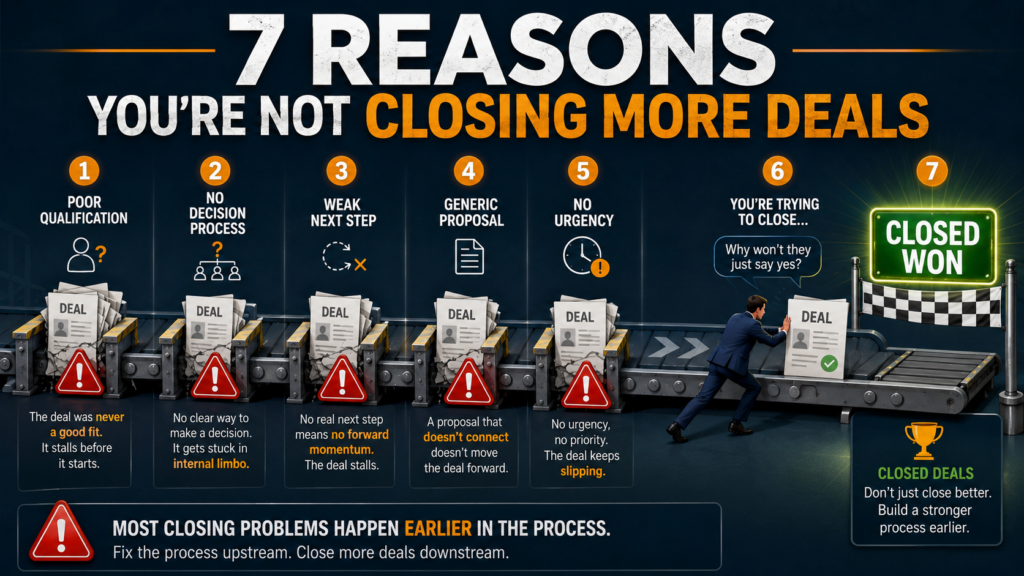
Every sales team wants to be closing more deals. But when deals stall, most companies look in the wrong place.
They blame the salesperson. They blame the price. They blame the economy. They blame the prospect for “going dark.”
Sometimes those things are true, but more often, the real problem happened much earlier in the sales process.
The deal was not qualified well enough. The business issue was not made clear. The decision process was not understood. The buyer was never helped to build internal support. The proposal was sent before the opportunity was real.
Closing problems usually start long before the close.
1. You Are Chasing Opportunities That Were Never Qualified
A full pipeline can be dangerous if it is full of weak opportunities. Too many sales teams confuse activity with progress. A prospect asks for information, takes a meeting, or requests a quote, and suddenly the opportunity is treated as real. But interest is not qualification.
A qualified opportunity should have a clear business issue, a reason to act, an identified decision process, a realistic timeline, and a fit between the buyer’s problem and your solution.
If those things are missing, you may not have a deal. You may just have a conversation.
2. You Have Not Created Enough Business Pain
Buyers do not change because your product is good. They change because staying the same has become too expensive, too risky, or too frustrating.
If the salesperson cannot clearly explain the cost of the problem, the buyer will struggle to justify action. That is when deals get delayed, pushed into the next quarter, or lost to “no decision.”
The issue is not always price. Many times, the issue is that the buyer does not see enough consequence in doing nothing. A strong sales process helps the buyer connect the problem to business impact. What is this costing them? What happens if they wait? Who else is affected? Why does this need to be solved now?
Without that clarity, the deal has no urgency.
3. You Are Selling Too Soon
A lot of salespeople start presenting before they fully understand the buyer.
They talk about capabilities, features, service, quality, experience, and responsiveness. Those things may be true, but they are not automatically meaningful to the buyer.
Modern buyers can find basic information on their own. They do not need a salesperson to repeat what is already on the website. They need help making sense of their situation, understanding their options, and building confidence in the right decision.
If your sales conversation sounds like a pitch before it sounds like a diagnosis, you are probably selling too soon.
4. You Do Not Understand the Real Decision Process
Many deals stall because the salesperson only knows the person they are talking to.
That person may like you. They may believe in your solution. They may even tell you the deal looks good. But if they are not the final decision maker, or if others have influence behind the scenes, you are exposed.
B2B buying is rarely a one-person decision anymore. Finance, operations, ownership, procurement, technical leaders, end users, and outside advisors may all have input.
If you do not know who is involved, what each person cares about, how the decision will be made, and what could stop the deal, you are not managing the opportunity. You are hoping.
5. You Are Not Building Enough Trust
Trust is not built by saying, “We provide great service.”
Every competitor says that.
Trust is built when the buyer believes you understand their business, their pressures, their risks, and their desired outcome. It is built when you ask better questions, tell the truth, challenge weak thinking, and follow through on what you said you would do.
Salesforce reported that 86% of B2B buyers are more likely to purchase when companies understand their goals, while 59% say reps do not take enough time to understand their unique challenges and objectives. That gap is where a lot of deals are lost.
If the buyer does not trust the salesperson’s understanding, they will not trust the recommendation.
6. Your Follow-Up Adds No Value
“Just checking in” is not a sales strategy.
If your follow-up only asks whether the buyer has made a decision, you are putting all the work on them. Good follow-up should move the conversation forward. It should summarize the business issue, reinforce the cost of inaction, clarify the next step, answer a concern, or help the buyer build internal support.
The goal is not to annoy the prospect into responding. The goal is to remain useful while the buyer works through the decision.
If every follow-up sounds the same, the buyer learns to ignore it.
7. You Do Not Have a Sales Management System
This is the one most CEOs and owners do not want to hear.
Some teams are not closing more deals because nobody is inspecting the right things. Pipeline reviews become status updates. Sales meetings become storytelling sessions. CRM stages are vague. Quotes go out without qualification. Follow-up is inconsistent. Forecasts are based on optimism instead of evidence.
A stronger close rate usually requires better sales management.
That means clear qualification standards, defined pipeline stages, deal coaching, CRM discipline, opportunity inspection, and accountability around next steps.
Salespeople need freedom to sell, but they also need structure. Without structure, every rep runs their own process. When every rep runs their own process, the company gets inconsistent results.
The Real Fix
If you want to start closing more deals, do not begin at the end of the sales process. Begin at the beginning.
Tighten qualification. Get clearer on the business issue. Understand the decision process. Help the buyer build internal consensus. Stop sending proposals too early. Improve follow-up. Coach the pipeline with discipline.
The best sales teams are not closing more deals because they have a magic closing line.
They are closing more deals because they create better opportunities, manage them more effectively, and give buyers a stronger reason to act.
FAQ
Why is my sales team not closing more deals?
Your sales team may not be closing more deals because the real problem is happening earlier in the sales process. Weak qualification, poor discovery, unclear buyer pain, vague next steps, and inconsistent follow-up all create sales closing problems later. By the time a deal reaches the proposal stage, it may already be too weak to close.
What are the most common reasons sales deals stall?
The most common reasons sales deals stall include a lack of urgency, no clear decision process, too many unknown stakeholders, weak business justification, poor follow-up, and proposals being sent too early. Many stalled deals are not lost to competitors. They are lost to indecision.
How can I improve my sales close rate?
To improve your sales close rate, start by tightening qualification standards. Make sure every opportunity has a clear business issue, defined decision process, measurable impact, timeline, budget fit, and next step. Better qualification usually leads to better closing because your sales team spends more time on real opportunities.
Is closing more deals about better sales techniques?
Not usually. Closing more deals is less about clever closing techniques and more about running a better sales process. Salespeople close more business when they understand the buyer’s problem, create urgency, identify decision makers, build trust, and manage the opportunity with discipline.
Why do prospects go dark after receiving a proposal?
Prospects often go dark after receiving a proposal because the salesperson moved too quickly to pricing before the buyer was fully qualified. The buyer may not understand the business value, may not have internal alignment, or may not feel enough urgency to act. Strong sales follow-up should reconnect the proposal to the buyer’s business problem and clarify the next step.
How does sales qualification help with closing more deals?
Sales qualification helps with closing more deals by separating real opportunities from weak ones. A qualified opportunity should have a business problem, consequence for inaction, decision process, timeline, authority, and fit. Without these elements, the opportunity may inflate the sales pipeline without increasing actual revenue.
What role does sales management play in improving close rates?
Sales management plays a major role in improving close rates. Sales managers should inspect the pipeline, coach opportunities, enforce qualification standards, review follow-up, and make sure CRM stages reflect reality. Without a strong sales management system, sales teams often confuse activity with progress.
How can CEOs tell if they have a sales process problem?
CEOs can spot a sales process problem by looking for patterns: too many stalled proposals, weak CRM notes, unclear next steps, poor forecast accuracy, long quote cycles, and opportunities sitting in the pipeline with no movement. These are signs the team may need better sales management, stronger qualification, and a more disciplined B2B sales process.
What should salespeople do before sending a proposal?
Before sending a proposal, salespeople should confirm the buyer’s business issue, decision criteria, decision process, timeline, budget expectations, and next step after the proposal is reviewed. Sending a proposal too early often creates stalled deals and lowers the close rate.
What is the best way to fix sales closing problems?
The best way to fix sales closing problems is to stop treating them as only closing problems. Start by improving the front end of the sales process. Strengthen discovery, qualify better, define the decision process, create business urgency, and coach each opportunity before the proposal goes out.
Transformative Sales Systems
812-924-7085
Schedule a 30 minute meeting: https://calendly.com/anthony-nicks/30min
Learn more about Fractional Sales Management at https://transformativesalessystems.com/sales-leadership/
Read more about Fractional Sales Management: https://www.amazon.com/dp/B0FLWSXX5D