
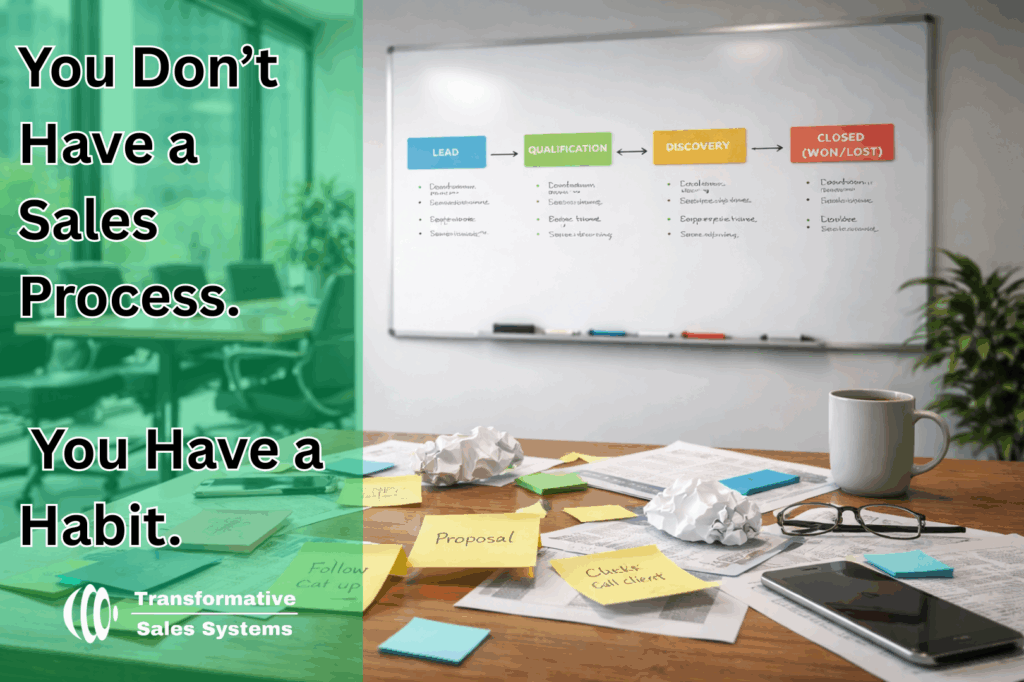
Most small and midsize businesses don’t have a sales process.
They have a pattern.
A routine.
A handful of things that “usually work” when the right salesperson is involved.
And that’s fine… until it isn’t.
Because habits don’t scale. Habits don’t onboard new hires. Habits don’t forecast revenue. And habits definitely don’t create predictable growth when the market tightens up or the pipeline gets weird.
A real sales process isn’t there to make salespeople robotic.
It’s there to make results repeatable.
The Real Problem: Your Best Salesperson Is Holding the Whole Thing Together
Here’s how this usually plays out.
You’ve got one or two reps who can close deals. Maybe they’ve been around a while. They “know the customer.” They know what to say. They know when to push and when to back off. They are consistent enough that you trust their number.
Then you hire someone else.
And suddenly you realize you never actually had a process.
You had a person.
A salesperson with good instincts is a great asset. But instincts aren’t a strategy. And when the company depends on those instincts to hit revenue, the business becomes fragile.
This is one of the biggest hidden risks inside SMB sales: when performance is driven by personality instead of process.
If Your Team Can’t Explain the Process… You Don’t Have One
Here’s the easiest test I know.
Ask three people on your team this question:
“What are the stages of our sales process, and what has to happen in each stage to move to the next one?”
If you get three different answers, you don’t have a sales process.
If you get a blank stare, you definitely don’t have a sales process.
If the answer is “we just kind of… know,” you don’t have a sales process.
And if the answer is “it depends,” you might have a business. But you don’t have a machine.
This matters because revenue predictability is directly tied to process clarity. If your team can’t define what “good” looks like, you can’t coach it, measure it, or improve it.
A Sales Process Isn’t a Script. It’s a System
Let me clear something up.
A sales process doesn’t mean:
-
using cheesy talk tracks
-
turning your team into telemarketers
-
forcing reps into fake “stages”
-
asking 37 discovery questions for no reason
A process is not about controlling the customer.
It’s about controlling what your salespeople do next.
A real sales process gives your team a structure that answers questions like:
-
What do we do in the first conversation?
-
How do we qualify a deal before we waste time?
-
What do we uncover during discovery to build urgency and value?
-
How do we prevent deals from stalling?
-
How do we handle competition without racing to the bottom on price?
-
How do we move a deal forward without “following up” forever?
If your process can’t answer those questions, the result will always be the same:
Your pipeline looks busy, but revenue stays inconsistent.
Most Sales Teams Don’t Lose Deals… They Drift Out of Them
This is the part CEOs don’t see, because it doesn’t show up in a report until the quarter is over.
The deal doesn’t die in a dramatic way.
Nobody says, “We chose your competitor.”
It just fades.
It becomes:
-
“Let’s circle back next month.”
-
“We’re still reviewing internally.”
-
“Send me something.”
-
“We’re not ready yet.”
-
“Budget got pushed.”
And your salesperson stays optimistic because the prospect was friendly.
But friendly doesn’t mean committed.
Most deals don’t disappear because the product wasn’t good. They disappear because the sales process didn’t create enough clarity, value, or urgency to earn the next step.
That is a process problem, not a “salesperson motivation” problem.
Your CRM Isn’t Your Sales Process
A lot of companies think their CRM stages are their process.
They’re not.
Your CRM might say:
-
Lead
-
Opportunity
-
Proposal
-
Closed Won / Closed Lost
That is not a sales process. That’s a filing cabinet.
A real sales process explains what the rep has to do to move a deal forward and what has to be true before they advance stages.
If there are no requirements, reps will advance deals based on feelings and emotion.
And when deals advance on feelings, forecasting becomes fantasy, with no basis in reality.
What a Real Sales Process Actually Looks Like
At a practical level, your sales process should include three things:
First, it needs clear stages. Not 19 stages. Not 4 vague buckets. Clear steps that match how your buyers buy.
Second, every stage needs entry and exit criteria. Meaning: what needs to happen before the deal is allowed to move forward.
Third, it needs to be coachable. Because the process becomes the framework you use to train new reps, run deal reviews, and drive improvement.
That’s it.
If it’s not clear, not measurable, and not coachable, it’s not a process.
It’s a habit.
Why SMB Sales Processes Fall Apart
Here are the most common reasons I see:
One, the process was built around the owner’s personality. It worked because the owner is the closer. Then they hire salespeople and wonder why nobody can replicate it.
Two, the process is too complicated. Somebody took a corporate process designed for a 200-person team and dropped it into a 6-person business. Everyone ignores it.
Three, the process was built in a vacuum. Leadership wrote it, sales never bought in, and now it lives in a Google Doc nobody opens.
Four, there is no accountability. When there’s no expectation to follow the process, the team goes back to whatever feels natural.
If any of those sound familiar, you’re not alone. But you are paying for it.
What You Can Fix This Week
If you’re a CEO or business owner and you want to take a real first step, do this:
-
Write down your current stages
Even if they’re messy. Capture how deals move today. -
Define what must be true to move to the next stage
Not “they seem interested.” Actual evidence.
Examples:
-
Qualified means they have a real problem you can solve, not just curiosity.
-
Discovery complete means you understand why they need this, why now, who decides, and what happens if they do nothing.
-
Proposal stage means the prospect agreed to review the proposal live, not “I emailed it.”
-
Identify where deals get stuck the most
That stage is where your biggest improvement opportunity lives.
You don’t need to overhaul the whole thing this week. You just need to stop pretending you have a process when you don’t.
This Is Where Sales Leadership Shows Up
A sales process doesn’t magically improve sales performance.
Sales leadership does.
Because leadership turns the process into:
-
coaching conversations
-
deal review standards
-
pipeline accountability
-
forecasting confidence
-
onboarding and training
-
consistent improvement
This is exactly why fractional sales management works so well for SMBs. Most companies don’t need a full-time VP of Sales yet.
But they do need someone who can build the system, implement it with the team, and run it weekly until it becomes normal.
Not as a project.
As the new standard.
If Your Sales Results Depend on “Good Reps,” You’re Exposed
Let’s call it what it is.
If the only way you hit numbers is by relying on a few talented people to figure it out, your company is exposed.
A real sales process reduces that risk.
It makes performance repeatable.
It makes coaching effective.
It makes revenue predictable.
And once you have that, growth stops being a guessing game.
It becomes something you can actually manage.
FAQs
1: What is a sales process?
A sales process is a defined set of steps your team follows to move a prospect from first contact to closed business, with clear requirements to advance stages.
2: Why do most small businesses struggle with sales consistency?
Because they rely on individual salesperson habits instead of a repeatable system that can be coached, measured, and improved.
3: What’s the difference between CRM stages and a sales process?
CRM stages track where a deal is stored. A sales process defines what must happen for a deal to progress.
4: How many stages should an SMB sales process have?
Most SMBs do best with 5–8 stages that match how buyers actually make decisions.
5: How do I know if my sales process is working?
If it improves conversion rates, shortens sales cycles, makes forecasting more accurate, and helps reps win without discounting, it’s working.
Want Help Building a Sales Process That Your Team Will Actually Use?
If you’re a CEO or business owner and you know you need a real process, but you don’t have the time to build it, implement it, and enforce it…this is exactly what we do at Transformative Sales Systems.
Our Fractional Sales Management approach helps you install a process that works in the real world, not a corporate binder that dies on a shelf.
If you want to talk, reach out and we’ll walk through what your sales process looks like today, where it’s breaking down, and what a fix would look like.
Transformative Sales Systems
812-924-7085
Schedule a 30 minute meeting: https://calendly.com/anthony-nicks/30min
Learn more about Fractional Sales Management at https://transformativesalessystems.com/sales-leadership/
Read more about Fractional Sales Management: https://www.amazon.com/dp/B0FLWSXX5D