
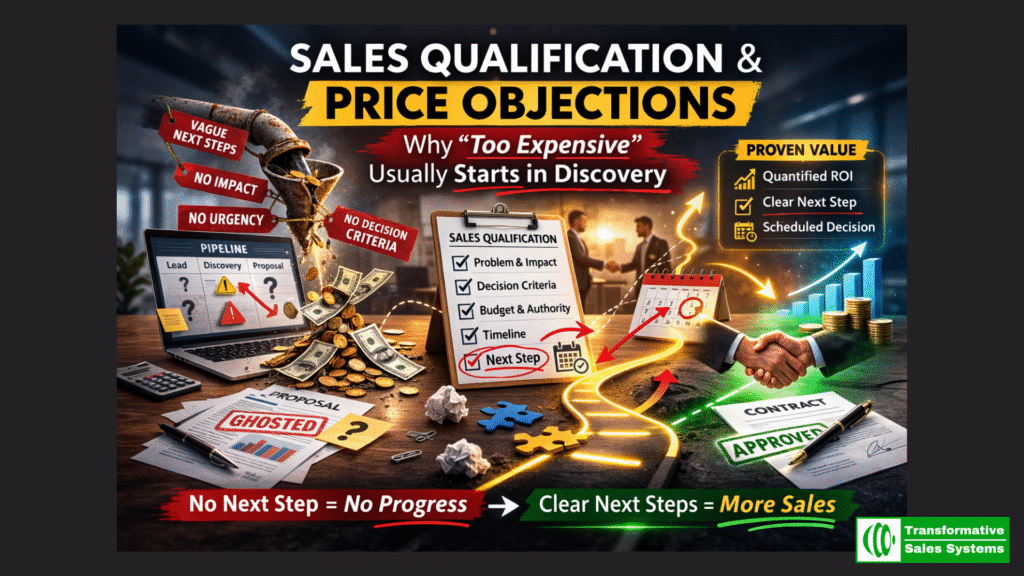
If you’re a CEO and you feel like your team is constantly losing deals on price, I’m going to challenge the assumption that price is the real problem. Sometimes it is. Many times it isn’t. In most SMB sales environments, “too expensive” is the symptom you hear at the end of the process, but the cause almost always shows up much earlier.
Price objections usually start in discovery.
They start when the salesperson doesn’t uncover enough specificity about the problem, the impact, and the urgency. They start when the buyer never clearly defines what success looks like, or what failure costs them. They start when the rep skips over decision criteria and ends up competing on generic claims like service, quality, and “we’ll take care of you.” They start when the deal gets advanced without meeting sales qualification standards.
If discovery is shallow, value stays generic. If value stays generic, price becomes the only thing the buyer can compare.
The real issue is not price. It is weak sales qualification.
When sales qualification is loose, salespeople advance opportunities based on interest and optimism instead of proof. They move deals into proposal because the buyer asked for it. They treat friendly conversations as commitment. They assume urgency without confirming it. They assume authority without mapping it. They assume the buyer sees the impact the same way they do.
That is how a pipeline fills up with deals that feel real but aren’t anchored to a business case. Then the proposal arrives, the buyer looks at the number, and the only question they can confidently answer is, “Is this cheaper somewhere else?”
That is not a buyer being difficult. That is a buyer reacting to a lack of clarity.
Sales qualification is supposed to prevent this. Qualification is the discipline of requiring proof before you invest deeper time and resources, including the time it takes to create a proposal and the credibility you risk when you throw pricing into a vacuum.
Why “too expensive” is often a polite way of saying “I don’t see the value”
Most buyers are not trying to offend your salesperson. “Too expensive” is often shorthand. It can mean a few different things, and sales qualification should help you identify which one it is.
Sometimes “too expensive” means they truly don’t have budget. Sometimes it means they had a different number in mind. Sometimes it means you are being compared to a competitor who framed the problem differently. Sometimes it means the buyer doesn’t understand what they get for the money. Sometimes it means the buyer isn’t convinced the problem is worth solving right now.
What most teams do wrong is treat price objection handling like a closing skill. They wait until the end, then try to talk the buyer into it.
But the strongest teams prevent price objections by building a business case in discovery. They make the buyer feel the weight of the problem, understand the cost of doing nothing, and define success in a way that makes the investment logical.
Sales qualification and price objections are connected through impact
If your discovery doesn’t quantify impact, your proposal will look like an expense.
When the buyer understands impact, your proposal becomes an investment.
That’s the entire game.
Impact can be financial, operational, strategic, or risk-based. It can show up as lost revenue, margin erosion, rework, missed production, churn, warranty costs, wasted labor hours, delays, safety exposure, or missed opportunities. The point is not to force a calculator into every conversation. The point is to move from vague pain to specific consequences.
Vague pain creates weak urgency. Weak urgency creates stalled deals. Stalled deals create discounting. Discounting creates margin problems. That chain reaction often starts because discovery never moved beyond small talk.
The sales qualification criteria that reduce price pressure
If you want fewer price objections, you need stronger sales qualification criteria before you quote anything. At a minimum, your reps should be able to answer these questions in plain language:
1. What is the specific problem we are solving?
2. What is the impact of that problem if it continues?
3. Why is this important now, and what happens if they delay?
4. How will they evaluate options, and what criteria matter most?
5. Who is involved in the decision, and what is the decision process?
6. What does success look like after implementation?
8. What is the mutually agreed next step, and when is it scheduled?
When those answers are clear, the buyer stops shopping you like a commodity because the conversation is no longer about “what do you charge.” It becomes about “what does it cost us if we don’t fix this” and “who is most likely to deliver the outcome we need.”
That is how you earn pricing power.
The discovery mistake that creates commodity comparisons
The most common mistake I hear from salespeople is leading discovery with their solution instead of the buyer’s reality. They talk about features, capabilities, and differentiators before the buyer has defined the problem in a way that matters.
This creates a predictable outcome. The buyer lumps you into the same category as everyone else because the buyer never built a personal business case for change. If the buyer’s language is generic, your solution will be evaluated generically.
That is why buyers ask for proposals and then disappear. The proposal is just another document in the pile, and the buyer is still unclear on what matters enough to decide.
Sales qualification is the guardrail that keeps you from quoting in the dark.
How to handle “we’re comparing you to someone cheaper” without discounting
When a buyer says they have a cheaper option, most salespeople immediately feel threatened. They either discount, justify, or start attacking the competitor. None of those approaches build credibility.
A better approach is to go back to sales qualification. You don’t argue about price. You clarify decision criteria.
You ask questions like, “When you compare options, what matters most besides price?” and “What happens if this goes wrong?” and “What does a win look like six months after you make this decision?” and “What made you look for a solution in the first place?”
These questions are not tricks. They are the core of qualification. They help you re-anchor the deal around outcomes and risk, not cost.
If the buyer insists price is the only factor, you have clarity. That may not be a winnable deal for you. And that is still a win, because you stop wasting time chasing deals you cannot profitably win.
Why proposals create price objections when the process is weak
In many SMBs, proposals are sent because the buyer asked for one, not because the deal is qualified. That almost guarantees price pressure.
If you send a proposal without a scheduled review meeting, you have no control over how it’s evaluated. The buyer may forward it to multiple people. The buyer may compare line items instead of outcomes. The buyer may misunderstand scope. The buyer may use your proposal to negotiate with someone else.
A proposal should be a tool to facilitate a decision, not a document you toss into the void.
A strong standard is simple: no proposal goes out without a scheduled proposal review meeting. That meeting is where you connect pricing back to impact, confirm requirements, validate decision criteria, and agree on next steps. Without it, you are training buyers to treat you like a quote machine.
The CEO move: stop rewarding “busy” and start rewarding “qualified”
If you want your team to stop discounting, you have to stop celebrating pipeline volume without pipeline quality. A bloated pipeline makes everyone feel productive while outcomes get worse.
CEOs can fix this by enforcing sales qualification standards in weekly deal reviews. The goal is not to interrogate salespeople. The goal is to stop letting vague deals advance.
When a rep says, “They think we’re too expensive,” the CEO question is, “Compared to what, and based on what criteria?” Then, “What impact did we quantify in discovery?” Then, “What happens if they do nothing?” Then, “When is the next decision meeting scheduled?”
If the answers are vague, the root cause is almost always discovery and qualification, not the price itself.
Where fractional sales management fits
Most SMBs don’t struggle with price objections because their offering isn’t valuable. They struggle because they don’t have consistent sales leadership enforcing sales qualification standards.
Salespeople do what feels natural. They rush to propose. They avoid hard questions. They assume urgency. They try to be liked. Then they get trapped in discounting because they never built a real business case.
Fractional Sales Management installs the standards, reinforces them weekly, coaches discovery in real deals, and keeps the pipeline clean until it becomes normal behavior. That is how you reduce price pressure without changing your pricing.
You don’t “handle” price objections better. You prevent them by qualifying better.
Bottom line
Price objections usually show up at the end, but they start in discovery. When sales qualification is weak, value is generic and price becomes the main comparison point.
If you want fewer discounts, fewer stalled proposals, and a pipeline that closes more predictably, tighten sales qualification standards before you quote anything. Make discovery specific, quantify impact, clarify decision criteria, and require mutually agreed next steps.
When the buyer understands the cost of the problem, the price of the solution stops being the headline.
FAQs
How are sales qualification and price objections connected?
Sales qualification prevents price objections by ensuring the buyer has a clear business case before pricing is discussed. When impact, urgency, and decision criteria are unclear, buyers compare on price because value is generic.
Why do buyers say “too expensive” even when they need the solution?
“Too expensive” often means the buyer doesn’t see enough value, doesn’t understand impact, or isn’t urgent. It can also mean they’re comparing vendors without clear decision criteria.
What sales qualification criteria reduce price objections?
Clear problem definition, quantified impact, a timeline with consequences, defined decision process, decision criteria, and a mutually agreed next step. These create clarity so price is evaluated against outcomes.
Should you send a proposal if the buyer is price shopping?
Not without clarifying decision criteria and scheduling a proposal review meeting. Sending proposals early often turns your offer into a price comparison and increases ghosting.
How do you respond when a buyer says a competitor is cheaper?
Return to qualification: clarify what matters besides price, confirm success criteria, quantify risk, and re-anchor the decision around outcomes. If price is the only factor, disqualify quickly.
How can a CEO reduce discounting without changing prices?
Enforce sales qualification standards in deal reviews, require proof before proposal stage, and coach discovery to quantify impact and urgency. Clean qualification reduces price pressure.
Transformative Sales Systems
812-924-7085
Schedule a 30 minute meeting: https://calendly.com/anthony-nicks/30min
Learn more about Fractional Sales Management at https://transformativesalessystems.com/sales-leadership/
Read more about Fractional Sales Management: https://www.amazon.com/dp/B0FLWSXX5D