
Your prospect may not come right out and say they do not believe your salesperson, but their behavior may be telling you the truth.
They delay. They ask for more information. They want to “think about it.” They compare you to cheaper options. They stop responding after the proposal. They ask for references late in the process. They bring up price even after your team believes value has been explained. They tell your salesperson they are interested, but they do not take the next step.
- Sometimes the issue is not budget.
- Sometimes the issue is not timing.
- Sometimes the issue is not the competition.
- Sometimes the issue is trust.
For CEOs and small business owners, this is a hard thing to see from the outside. The salesperson may be active. They may be professional. They may be saying the things you expect them to say. They may be talking about quality, service, responsiveness, experience, and customer relationships.
But the buyer may still not believe them.
That is the trust gap.
And building trust in sales requires more than saying the right words. It requires clarity, relevance, proof, consistency, and a sales process that helps the buyer feel confident instead of pressured.
Buyers Are More Skeptical Than Sales Teams Realize
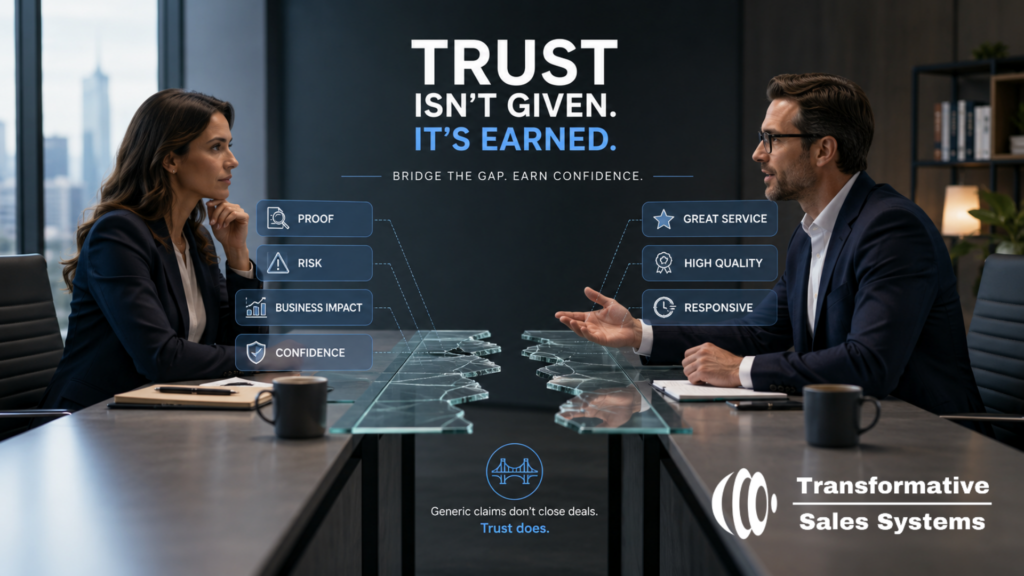
Today’s buyers have heard a lot of sales claims. They have heard companies say they have great service. They have heard companies say they are different. They have heard companies say they are responsive. They have heard companies say they care about customers. They have heard companies say they have the best solution. They have heard companies say they are not like everyone else.
The problem is not always that these claims are false…the problem is that buyers have heard them too many times.
When every competitor says some version of the same thing, the buyer stops treating those statements as meaningful. They become background noise. They may be true, but they do not build trust by themselves.
This is especially important for SMBs. Many small and midsize companies really do care about customers. They really do work hard. They really do have experience. They really do offer better service than some of their competitors.
But if the sales team cannot translate those strengths into specific buyer value, the message falls flat.
- A salesperson saying, “We have great service,” is not the same as proving what great service means to that buyer.
- A salesperson saying, “We are responsive,” is not the same as explaining how responsiveness reduces downtime, avoids missed deadlines, improves communication, or lowers risk.
- A salesperson saying, “We are high quality,” is not the same as showing how quality affects the buyer’s cost, performance, customer satisfaction, or operational stability.
Sales trust is not built through generic claims…building trust in sales is when the buyer sees that the salesperson understands their world.
Generic Sales Claims Do Not Build Sales Trust
One of the fastest ways for a sales team to lose credibility is to sound like every other sales team and this happens more often than most CEOs realize.
A salesperson gets in front of a prospect and says, “We are a customer-focused company with great service, strong quality, and years of experience.” and that may be true, but the buyer has probably heard the same thing from three other companies.
So what happens?
The buyer starts looking for another way to compare.
Price becomes the easiest comparison point.
That does not always mean the buyer only cares about price. Sometimes the buyer defaults to price because the salesperson has not created a better reason to evaluate the decision differently.
This is where Differentiating Value matters.
Your sales team needs to be able to explain why your company is different in a way that matters to the buyer. Not different in a way that sounds good internally. Different in a way that helps the buyer understand why choosing you creates a better outcome, lowers a risk, solves a specific problem, or prevents a costly mistake.
For example, a weak message sounds like this:
“We pride ourselves on responsiveness.”
A stronger message sounds like this:
“When your production team has an issue, waiting two days for an answer can delay shipments and create problems with your customer. Our process is built around same-day technical response because we know speed matters when downtime is expensive.”
That is different.
The first statement is a claim.
The second statement connects the claim to a business issue.
That is how trust starts to build.
Building Trust in Sales Starts with Better Discovery
A lot of salespeople try to build trust by talking. They want to explain the company. They want to talk about experience. They want to present the solution. They want to tell the buyer why they are different.
But trust usually starts with better discovery.
The buyer begins to trust the salesperson when the salesperson asks questions that make the buyer think. Not surface-level questions. Not checklist questions. Not questions that are obviously just being asked so the salesperson can get to the pitch.
Good discovery shows the buyer that the salesperson is trying to understand the real issue.
What prompted the conversation now? What problem are you trying to solve? What happens if this does not get fixed? Who else is affected by this issue? What have you already tried? What would make this decision difficult internally? What would make this solution successful six months from now?
Those questions create a different kind of conversation and the buyer starts to feel like the salesperson is not just trying to sell something. They are trying to understand.
That matters.
For example, imagine a prospect says, “We need a new vendor because our current one is not responsive.”
A weak salesperson hears that and immediately says, “We are very responsive. That is one of our strengths.”
A stronger salesperson slows down and asks, “When you say they are not responsive, what does that actually look like? Are they slow to quote, slow to return calls, slow to solve problems, or slow to deliver?”
That question builds trust because it shows the salesperson is not assuming they understand the issue.
The prospect may respond, “It is mostly after the order. When something changes, we cannot get answers fast enough, and it causes problems with our schedule.”
Now the salesperson has something real.
Now they can connect value to the buyer’s actual pain.
That is consultative selling…and it builds more trust than a generic claim ever will.
Relevance Builds More Sales Trust Than Enthusiasm
Enthusiasm is good, but enthusiasm by itself does not build trust.
Salespeople can be excited about the company, excited about the product, excited about the service, and excited about helping the customer. That energy can be positive. But if the salesperson is not relevant, enthusiasm becomes noise and buyers do not trust salespeople because they are excited.
They trust salespeople because they are useful, that is an important distinction. A salesperson who talks too much, presents too early, or explains features the buyer does not care about may be enthusiastic, but they may also be creating doubt. The buyer may start thinking, “This person does not really understand what we need.”
Relevance changes that.
A relevant salesperson connects the conversation to the buyer’s specific issue. They talk about the business impact. They bring up concerns the buyer may not have considered. They share examples that fit the buyer’s situation. They tailor the message instead of delivering the same pitch to everyone.
For example, if a manufacturer is dealing with missed delivery dates, the salesperson should not lead with a long overview of every capability the company offers. They should focus on how the solution affects lead time, communication, production planning, and risk reduction.
If a business owner is worried about inconsistent revenue, the salesperson should not start with a generic description of services. They should talk about pipeline quality, sales process, accountability, conversion, and the management cadence required to create predictability.
That is relevance.
And relevance builds trust because the buyer feels understood.
Proof Matters More Than Promises
Sales teams often overestimate the power of promises.
- “We can handle that.”
- “We are good at this.”
- “We will take care of you.”
- “You can trust us.”
Those statements may be sincere, but buyers need more than sincerity…they need proof.
Proof does not always have to be complicated. It can come in the form of relevant examples, case studies, process explanation, customer stories, references, metrics, testimonials, or a clear explanation of how your team prevents common problems and the key is that the proof has to match the buyer’s concern.
- If the buyer is worried about implementation risk, proof should show how you manage implementation.
- If the buyer is worried about response time, proof should show how your communication process works.
- If the buyer is worried about quality, proof should show how quality is controlled, measured, and protected.
- If the buyer is worried about internal adoption, proof should show how you support change and make the process easier for their team.
For example, if a prospect says, “We have had issues with vendors overpromising and then missing deadlines,” a weak salesperson says, “We understand. That will not happen with us.”
A stronger salesperson says, “That is a fair concern. Here is how we manage that. Before we commit to a delivery date, we review capacity, confirm technical requirements, assign ownership internally, and communicate any risk early. We also hold a weekly internal review on open projects so we do not wait until something is late to address it.”
That builds trust.
The salesperson is not just promising a better outcome…they are showing the process behind the outcome.
That is what buyers need.
Weak Follow-Up Damages Trust
Follow-up is one of the places where sales trust is either strengthened or weakened. A salesperson may have a decent first conversation, then damage the opportunity with weak follow-up.
The most common example is the classic “just checking in” email.
“Just checking in to see if you had a chance to review the proposal.”
That is not a trust-building message. It adds no value. It does not reconnect to the buyer’s issue. It does not clarify the decision process. It does not create urgency. It does not help the buyer think.
It simply asks the buyer to do the work.
A stronger follow-up reminds the buyer why the conversation matters.
For example:
“When we spoke, you mentioned that the current process is creating delays for your operations team and causing extra work for customer service. That seemed to be the main issue driving the conversation. Would it make sense to review the proposal together and compare the options against the impact of leaving the current process unchanged?”
That is different.
It shows the salesperson listened. It ties back to the business problem. It creates a reason for a conversation. It gives the buyer something to respond to.
Trust is built through consistency. If the salesperson asks good questions in the meeting but sends generic follow-up afterward, the buyer feels the disconnect.
Every interaction either builds trust or weakens it.
There is no middle ground here.
Your Proposal Either Builds Trust or Creates Doubt
A proposal is not just a price document. It is part of the sales conversation and it either builds trust or creates doubt.
Too many proposals are sent too early, with too little context, and no scheduled review. The buyer asks for pricing. The salesperson sends the proposal. Then the salesperson waits.
That is not a strong sales process.
A proposal should confirm that the salesperson understood the buyer’s issue. It should connect the recommended solution to the business problem. It should explain why the approach makes sense. It should clarify outcomes, assumptions, responsibilities, timing, and next steps.
- If the proposal feels generic, the buyer may assume the solution is also generic.
- If the proposal does not reflect the discovery conversation, the buyer may wonder whether the salesperson was listening.
- If the proposal focuses only on price and deliverables, the buyer may evaluate it like a commodity.
For example, a weak proposal says, “Here is the scope and pricing.”
A stronger proposal says, “Based on our conversation, the primary issue is inconsistent response time from your current provider, which is creating production delays and forcing your team to spend additional time resolving avoidable issues. The recommendation below is designed to improve response time, clarify communication, and reduce the operational risk you described.”
That type of proposal builds trust because it connects the solution to the buyer’s reality. It proves the salesperson was paying attention.
Trust Requires Sales Process Discipline
Building trust in sales is not just about personality. It is not just about being likable. It is not just about having a good relationship. Those things may help, but they are not enough.
Trust also requires sales process discipline.
The salesperson needs to prepare for the call. They need to ask good questions. They need to listen. They need to qualify properly. They need to understand the decision process. They need to create buyer-owned next steps. They need to follow up with relevance. They need to send proposals that reflect the conversation. They need to do what they said they would do.
This is where sales leadership matters.
If every salesperson on the team runs their own process, trust becomes inconsistent. One salesperson may do strong discovery. Another may pitch too early. One may follow up with relevance. Another may send generic reminders. One may explain Differentiating Value clearly. Another may sound like every competitor.
That inconsistency creates risk.
A CEO may believe the company has a strong reputation, but the buyer experiences the company through the salesperson. If the salesperson creates confusion, pressure, or doubt, the company’s credibility suffers.
That is why trust must be managed.
Not manipulated.
Managed.
Sales leaders should inspect the behaviors that build trust. Are salespeople asking the right questions? Are they listening more than they talk? Are they qualifying before proposing? Are they connecting value to business impact? Are they following up with relevance? Are they creating clear next steps? Are they representing the company’s value consistently?
Trust should not be left to chance.
Buyer Skepticism Shows Up in the Pipeline
One of the reasons trust matters so much is that lack of trust often shows up as pipeline friction. Deals stall. Prospects go quiet. Buyers ask for more information. Price becomes a bigger issue. Decisions get delayed. Additional stakeholders appear late. Proposals sit without response. Salespeople keep following up but nothing moves.
When this happens, sales teams often explain it as timing, budget, or the buyer being busy and sometimes that is true.
But sometimes the buyer is not moving because they are not confident.
They may not be confident in the salesperson. They may not be confident in the company. They may not be confident in the solution. They may not be confident that the value outweighs the risk. They may not be confident enough to defend the decision internally.
That is a trust issue.
For example, if a buyer keeps asking for more information but never agrees to a next step, they may not be asking for information because they need more facts. They may be asking because they are not convinced.
If a buyer keeps comparing you to a cheaper option, they may not be doing that because price is the only issue. They may be doing it because your salesperson has not created enough separation. Or the buyer ghosts after the proposal, they may not be disorganized. They may have received a proposal that did not create confidence.
This is why trust is not a soft issue.
- Trust affects conversion.
- Trust affects deal movement.
- Trust affects forecast accuracy.
- Trust affects revenue.
What CEOs Should Inspect
If you are a CEO or small business owner, you do not need to sit in every sales call. But you do need to understand whether your sales team is building trust or relying on claims.
- Start by looking at the language your salespeople use.
- Are they saying things any competitor could say? Are they explaining your value in a way that connects to the buyer’s actual business issue? Are they using examples and proof, or are they relying on promises?
- Then look at discovery.
- Are salespeople asking questions that uncover business impact, decision process, urgency, risk, and internal stakeholders? Or are they asking a few basic questions and moving quickly to presentation?
- Look at proposals.
- Do proposals reflect the buyer’s problem, or do they simply list scope and pricing? Do they build confidence, or do they invite price comparison?
- Look at follow-up.
- Is follow-up meaningful, or is it mostly “just checking in”? Does the salesperson bring value back into the conversation, or are they simply asking whether the buyer has made a decision?
- Look at pipeline behavior.
- Are deals stalling after proposals? Are buyers going quiet? Are close dates slipping? Are price objections showing up late? Are opportunities moving without clear buyer commitment?
Those are signals and signals need to be inspected.
The issue may not be that your team needs to work harder….the issue may be that your team needs to build more trust.
The Bottom Line on Building Trust in Sales
Building trust in sales is not about having a friendly salesperson.
- It is not about saying the company has great service.
- It is not about claiming to be different.
- It is not about telling the buyer they can trust you.
- Trust is earned through the way the salesperson sells.
It is earned through preparation, discovery, relevance, proof, consistency, follow-up, proposal quality, and process discipline.
- Buyers trust salespeople who help them think more clearly.
- They trust salespeople who understand their problem.
- They trust salespeople who connect value to business impact.
- They trust salespeople who provide proof instead of promises.
- They trust salespeople who do what they say they will do.
- They trust salespeople who make the decision easier, not harder.
For CEOs and SMB business owners, this matters because building trust in sales is directly connected to revenue. When sales trust is weak, deals stall. Price pressure increases. Buyers hesitate. Forecasts slip. Salespeople chase. Pipeline quality suffers.
When trust is strong, the buyer engages more openly. They share better information. They involve the right people. They commit to next steps. They view your team as a guide instead of just another vendor.
That is the difference.
Your sales team may be saying the right things, but the real question is whether your buyers believe them and if they do not, the answer is not more claims.
The answer is better selling.
Call to Action
If your prospects are delaying, going quiet, challenging price, or failing to move forward after what seem like good sales conversations, trust may be the issue.
Transformative Sales Systems helps small and midsize businesses build the sales leadership, messaging, process, and coaching needed to improve buyer confidence and sales performance.
Before you ask your sales team to push harder, make sure they are building enough trust for the buyer to move forward.
FAQ Section
What does building trust in sales mean?
Building trust in sales means creating buyer confidence through preparation, good discovery, relevant messaging, proof, consistent follow-up, and a clear sales process. Trust is earned when the buyer believes the salesperson understands the problem, can provide value, and will help reduce risk.
Why do prospects not trust salespeople?
Prospects may not trust salespeople because they hear too many generic claims, feel pressured too early, do not see enough proof, or believe the salesperson does not fully understand their problem. Buyer skepticism often increases when sales messaging sounds like every competitor.
How can salespeople build trust with prospects?
Salespeople build trust by asking better questions, listening carefully, connecting value to the buyer’s business issue, providing relevant proof, following up with purpose, and doing what they said they would do. Trust grows when the buyer feels understood and supported.
Why does trust matter in B2B sales?
Trust matters in B2B sales because buyers are making decisions that affect budget, operations, risk, performance, and internal credibility. If they do not trust the salesperson or the company, they are more likely to delay, compare on price, request more information, or avoid making a decision.
How does weak sales messaging hurt trust?
Weak sales messaging hurts trust when it relies on generic claims such as great service, high quality, responsiveness, and experience without connecting those claims to the buyer’s specific problem. Buyers need to understand why those strengths matter to their situation.
What role does proof play in building trust in sales?
Proof helps buyers believe the salesperson’s claims. Proof can include relevant examples, customer stories, case studies, process explanations, testimonials, references, metrics, or clear evidence that the company can solve the buyer’s problem.
How can CEOs tell if their sales team is building trust?
CEOs can inspect sales calls, follow-up emails, proposals, CRM notes, and pipeline behavior. Signs of weak trust include stalled deals, late price objections, buyers going quiet, vague next steps, repeated requests for more information, and proposals that do not move forward.
Transformative Sales Systems
812-924-7085
Schedule a 30 minute meeting: https://calendly.com/anthony-nicks/30min
Learn more about Fractional Sales Management at https://transformativesalessystems.com/sales-leadership/
Read more about Fractional Sales Management: https://www.amazon.com/dp/B0FLWSXX5D