
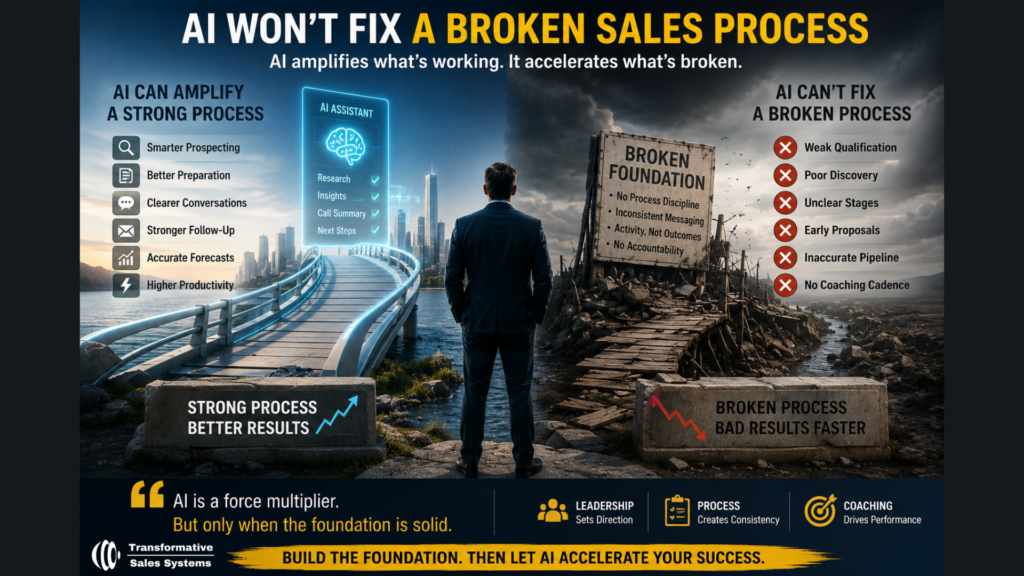
AI in sales is getting a lot of attention, and for good reason.
It can help salespeople research prospects faster. It can summarize calls. It can draft follow-up emails. It can help prepare for meetings. It can improve CRM notes. It can support lead scoring, call intelligence, workflow automation, content generation, and sales productivity. Those are real benefits. Apollo, for example, describes AI’s productivity role in sales across areas such as content generation, call intelligence, lead scoring, and workflow automation.
But here is the problem.
AI can make your sales team faster. That does not mean it will make them better.
If your sales process is broken, AI will not fix it. It may simply help your team execute bad habits faster, cleaner, and with more polished language.
That is the part many CEOs, business owners, and sales leaders need to think about before they chase the next AI tool.
AI in sales is not a substitute for sales leadership. It is not a replacement for a defined sales process. It is not a magic solution for poor qualification, weak discovery, inconsistent follow-up, inaccurate CRM data, bloated pipelines, or salespeople who confuse activity with progress.
AI can support a good sales system.
It cannot create one for you.
AI in Sales Is a Tool, Not a Strategy
The first mistake companies make with AI in sales is treating it like a strategy.
It is not.
AI is a tool. It can improve execution, increase speed, reduce administrative work, and make certain tasks easier. But AI does not decide who your ideal customer is. It does not define your sales stages. It does not create your qualification standards. It does not determine what makes an opportunity real. It does not coach your salespeople through difficult conversations. It does not hold your team accountable when they avoid prospecting, skip discovery, or advance weak deals in the CRM.
That is sales leadership.
This is where small and midsize businesses need to be careful. A new tool can create the appearance of progress. The team starts using AI for emails, call notes, prospect research, and CRM updates. Everyone feels more modern. Everyone feels more efficient.
But the real question is not whether your team is using AI.
The real question is whether your team has a sales process worth improving.
If the process is unclear, inconsistent, or poorly managed, AI becomes another layer of technology sitting on top of a weak foundation. It may make the work look more organized, but it will not necessarily make the sales team more effective.
AI Can Improve Execution
Let’s be clear. I am not anti-AI. I use it in my business daily and used properly, AI in sales can be incredibly useful.
A salesperson can use AI to prepare for a meeting by researching a company, identifying potential business issues, summarizing public information, and developing better questions. AI can help draft follow-up emails that are more timely and relevant. It can summarize sales calls, identify action items, and help keep CRM notes cleaner. It can assist with prospecting lists, messaging ideas, proposal language, and content development.
Read.ai describes sales AI as helping teams reduce administrative work, surface deal context, connect meetings and CRM activity, and support post-call workflows. Revenue intelligence platforms are also using conversation analytics to support coaching and leadership visibility.
Those are all valuable applications.
For a disciplined sales team, AI can make good habits easier to execute. It can reduce the time spent on administrative tasks. It can help salespeople prepare more thoroughly. It can make follow-up more consistent. It can give sales managers better visibility into conversations, next steps, and deal activity.
That matters.
But the key phrase is “disciplined sales team.”
AI helps most when there is already a clear process, defined expectations, and strong management cadence. Without those things, AI may simply create more activity without more progress.
And more activity is not the same as better selling.
AI Cannot Fix Poor Qualification
Poor qualification is one of the biggest issues in sales, and AI will not solve it by itself. If your salespeople do not know what makes an opportunity real, AI will not magically create that judgment for them.
A salesperson can use AI to research a prospect. They can use AI to draft discovery questions. They can use AI to summarize a conversation. But they still have to understand whether the buyer has a real problem, a compelling reason to act, decision authority, budget expectations, timing, urgency, and a path to a decision.
That requires sales skill and also requires standards.
Too many sales teams treat interest as qualification. A prospect asks for information, and suddenly they are in the pipeline. A prospect requests a quote, and suddenly the opportunity is forecasted. A prospect says, “Send me something,” and the salesperson thinks the deal is moving forward.
That is not qualification, that is just hope.
AI can make that hope look better documented. It can write a cleaner summary. It can draft a better follow-up. It can update the CRM more neatly, but if the opportunity was never truly qualified, the problem remains.
A bad deal with better notes is still a bad deal.
This is why sales process improvement has to come before AI automation. Before you ask AI to help move deals through the process, you need to define what belongs in the process in the first place.
AI Cannot Replace Discovery
Discovery is not just asking questions.
Discovery is diagnosis.
The salesperson has to understand what the buyer is trying to solve, why it matters, what happens if nothing changes, who is involved, how the decision will be made, what risks exist, what alternatives are being considered, and what criteria will be used to compare options.
AI can help prepare for discovery.
It can suggest questions. It can summarize answers. It can identify patterns after the call. It can help a salesperson review what was said and what was missed.
But AI does not replace the human skill of listening, probing, reading hesitation, recognizing inconsistency, asking a tough follow-up question, or knowing when the buyer is giving a surface-level answer.
That still belongs to the salesperson.
This is especially important in consultative selling. If your team is selling something complex, customized, technical, expensive, or tied to business risk, discovery matters even more. The buyer does not need a salesperson who simply captures information. They need a salesperson who helps them think.
AI may support that process.
It cannot own it.
AI Can Make Bad Follow-Up Sound Better
One of the most common uses of AI in sales is email writing.
That can be helpful. Many salespeople struggle to write clear, concise, relevant follow-up. AI can help organize the message, summarize the conversation, personalize the opening, and make the next step easier to understand.
But there is a trap.
AI can make weak follow-up sound professional.
If the salesperson has no real next step, no buyer commitment, no reason for urgency, and no clear value to bring back to the conversation, AI can still produce a polished email.
That does not make the follow-up effective.
It just makes the lack of progress sound better.
There is a big difference between a well-written email and a meaningful sales next step. The goal is not to “touch base” in more elegant language. The goal is to move the buyer’s decision process forward.
A strong follow-up should reinforce what was discussed, clarify the business issue, confirm buyer-owned next steps, and create a reason for continued engagement.
AI can help write that message.
But the salesperson still has to earn the right to send it.
AI Can Make a Bad Pipeline Look More Organized
This may be the biggest danger for sales leaders.
AI can improve CRM hygiene. It can summarize calls, log notes, suggest next steps, update fields, and help managers see activity more clearly. That can be a major improvement, especially for sales teams that struggle with CRM discipline.
But a cleaner CRM does not automatically mean a healthier pipeline.
- If your sales stages are poorly defined, AI will not fix that.
- If opportunities are being advanced based on seller activity instead of buyer commitment, AI will not fix that.
- If old deals are sitting in the pipeline because nobody wants to close them out, AI will not fix that.
- If probabilities are based on optimism instead of evidence, AI will not fix that.
- If the team does not have clear entrance and exit criteria for each stage, AI will not fix that.
It may simply make the pipeline look more professional while the forecast remains unreliable.
That is a dangerous place for a CEO. The dashboard looks better. The notes are cleaner. The follow-up tasks are more organized. But the revenue still does not show up.
This is why CRM discipline has to be connected to sales process discipline. The CRM should reflect reality. It should not become a better-looking version of wishful thinking.
AI Cannot Coach Your Sales Team Like a Sales Manager
AI in sales management has real potential.
It can analyze call transcripts. It can identify talk ratios. It can flag missed questions. It can summarize objections. It can help managers see patterns across the team. It can support coaching by giving the sales manager better information.
That is useful.
But AI is not the sales manager.
AI cannot fully understand the individual salesperson’s mindset, habits, confidence level, motivation, excuses, skill gaps, and behavior patterns. It cannot replace the hard conversation after a salesperson skips prospecting. It cannot role-play with the same accountability and judgment as a strong sales leader. It cannot decide when someone needs encouragement, correction, pressure, or a change in responsibility.
Sales coaching is not just information transfer.
It is behavior change.
And behavior change requires leadership.
A sales manager has to inspect, coach, reinforce, challenge, and hold people accountable. AI can help the manager see more, but the manager still has to manage.
This is especially important for SMBs where the sales manager role is often underdeveloped, part-time, owner-led, or pushed onto the top salesperson. In that environment, AI may provide more data, but more data does not automatically create better leadership.
Someone still has to interpret it.
Someone still has to act on it.
AI Will Not Fix Weak Messaging
If your sales messaging is generic, AI may help you produce more generic messaging faster.
That is not a win.
Many sales teams already struggle to explain why their company is different. They talk about service, quality, responsiveness, experience, and relationships. Those things may be true, but they are also the same things most competitors say.
AI can draft emails and sales copy using those same generic inputs. If the salesperson does not understand the company’s Differentiating Value, the AI output will likely reflect that weakness.
Better wording does not equal better positioning.
Your sales team still needs clear messaging. They need to know what problems you solve, what risks you reduce, what outcomes you improve, where you are meaningfully different, and why the buyer should care.
AI can help refine that message.
It cannot invent your value if your company has not defined it.
This is another reason sales leadership matters. Messaging should not be left entirely to individual salespeople or random AI prompts. It needs to be defined, reinforced, practiced, and inspected.
Otherwise, your team will have more content but not necessarily more clarity.
The Real Question: Is Your Sales Process Worth Automating?
Before you add more AI tools, ask a harder question.
Is your sales process worth automating?
Because if your current sales process is built on weak qualification, early proposals, inconsistent discovery, unclear next steps, and loose pipeline management, automation may just help you scale the wrong behavior.
That is not transformation.
That is acceleration without direction.
A good sales process should help the team answer important questions:
- Who is our ideal customer?
- What problems do we solve best?
- What makes an opportunity qualified?
- What must happen before we send a proposal?
- What are the entrance and exit criteria for each pipeline stage?
- What buyer commitments are required before a deal moves forward?
- What does a strong discovery conversation include?
- What does good follow-up look like?
- What metrics actually indicate progress?
- How do we coach salespeople when deals stall?
If those questions are not answered, AI will have very little structure to support.
This is where CEOs and business owners need to slow down. Do not start with, “What AI tool should we buy?”
Start with, “What sales behavior are we trying to improve?”
That changes the conversation.
Where CEOs Should Start Before Adding More AI
If you are leading a small or midsize business, AI may absolutely belong in your sales organization. But it should be introduced into a system that has enough structure to benefit from it.
Before investing heavily in AI in sales, start with the fundamentals.
- Make sure your ideal customer profile is clear.
- Define your sales stages and the entrance and exit criteria for each stage.
- Clarify what makes an opportunity qualified.
- Create standards for discovery, proposals, follow-up, and pipeline movement.
- Review whether your CRM reflects how buyers actually buy.
- Train the team on messaging and Differentiating Value.
- Establish a consistent sales meeting and one-on-one coaching cadence.
- Inspect whether activity is creating real sales progress.
Once those pieces are in place, AI becomes much more useful.
Then AI can help with research, preparation, follow-up, CRM updates, call summaries, coaching insights, and productivity. It can become a force multiplier.
But without the fundamentals, AI is just another tool dropped into a messy sales environment.
And messy sales environments do not usually need more tools.
They need more leadership.
AI Should Support Sales Leadership, Not Replace It
The best use of AI in sales is not to remove leadership from the process.
It is to give leadership better visibility and help salespeople execute the right behaviors more consistently.
AI can help a sales manager prepare for a pipeline review. It can summarize deal activity. It can flag opportunities without next steps. It can identify stalled deals. It can help compare call notes to qualification criteria. It can surface coaching opportunities.
That can make sales management more effective.
But only if the sales manager knows what to look for.
This is why AI in sales management should be viewed as leverage, not replacement. The manager still has to ask the hard questions. The manager still has to challenge weak assumptions. The manager still has to coach the salesperson. The manager still has to enforce the process.
AI can make the manager more informed.
It cannot make the manager more courageous.
The Bottom Line on AI in Sales
AI in sales is useful.
It can save time. It can improve preparation. It can clean up CRM notes. It can support follow-up. It can summarize calls. It can help managers identify coaching opportunities. It can improve sales productivity when it is used inside a well-managed sales system.
But AI will not fix a broken sales process.
- It will not turn poor qualification into strong qualification.
- It will not turn weak discovery into consultative selling.
- It will not turn bad messaging into Differentiating Value.
- It will not turn a bloated pipeline into a reliable forecast.
- It will not turn an absent sales manager into real sales leadership.
AI can make your sales team faster.
Sales leadership makes your sales team better.
That is the distinction.
For CEOs and business owners, the lesson is straightforward: do not confuse technology adoption with sales improvement. Before you invest in more AI tools, make sure your sales process, messaging, management cadence, and accountability structure are strong enough to benefit from them.
Otherwise, you may not be fixing the problem.
You may just be automating it.
FAQs
What is AI in sales?
AI in sales refers to the use of artificial intelligence tools to support sales activities such as prospect research, email writing, call summaries, CRM updates, lead scoring, meeting preparation, forecasting, and sales coaching insights. AI can improve efficiency, but it works best when it supports a clear sales process.
Can AI fix a broken sales process?
No. AI can support a strong sales process, but it cannot fix poor qualification, weak discovery, unclear sales stages, bad messaging, inconsistent coaching, or lack of accountability. If the sales process is broken, AI may simply help the team execute bad habits faster.
How can AI improve sales productivity?
AI can improve sales productivity by reducing administrative work, helping salespeople prepare for meetings, drafting follow-up emails, summarizing calls, updating CRM records, and identifying useful deal insights. These benefits are most valuable when the team already has clear expectations and a disciplined sales process.
What should companies do before adopting AI in sales?
Before adopting AI in sales, companies should define their ideal customer profile, clarify sales stages, establish qualification standards, improve CRM discipline, strengthen messaging, and create a consistent sales coaching cadence. AI is more effective when it is added to a structured sales system.
Is AI in sales management useful?
Yes. AI in sales management can help managers review call activity, identify coaching opportunities, summarize deal progress, and improve visibility into the pipeline. However, AI does not replace the sales manager’s role in coaching, accountability, decision-making, and leadership.
Can AI help with sales coaching?
AI can support sales coaching by analyzing calls, summarizing conversations, identifying missed questions, and highlighting patterns. But sales coaching still requires a manager who can interpret the information, coach behavior, role-play, challenge assumptions, and hold the salesperson accountable.
Why does sales leadership still matter if AI can automate sales tasks?
Sales leadership still matters because sales is not just a task-management function. Sales teams need direction, coaching, standards, accountability, messaging, process discipline, and deal strategy. AI can automate tasks, but leadership improves judgment and behavior.
Call to Action
If your sales team is exploring AI but still struggling with qualification, pipeline discipline, messaging, follow-up, or sales accountability, the tool is probably not the real issue.
Transformative Sales Systems helps small and midsize businesses build the sales leadership, structure, process, and accountability needed to turn sales activity into real revenue progress.
Before you ask what AI can do for your sales team, make sure your sales process is worth improving.
Transformative Sales Systems
812-924-7085
Schedule a 30 minute meeting: https://calendly.com/anthony-nicks/30min
Learn more about Fractional Sales Management at https://transformativesalessystems.com/sales-leadership/
Read more about Fractional Sales Management: https://www.amazon.com/dp/B0FLWSXX5D