
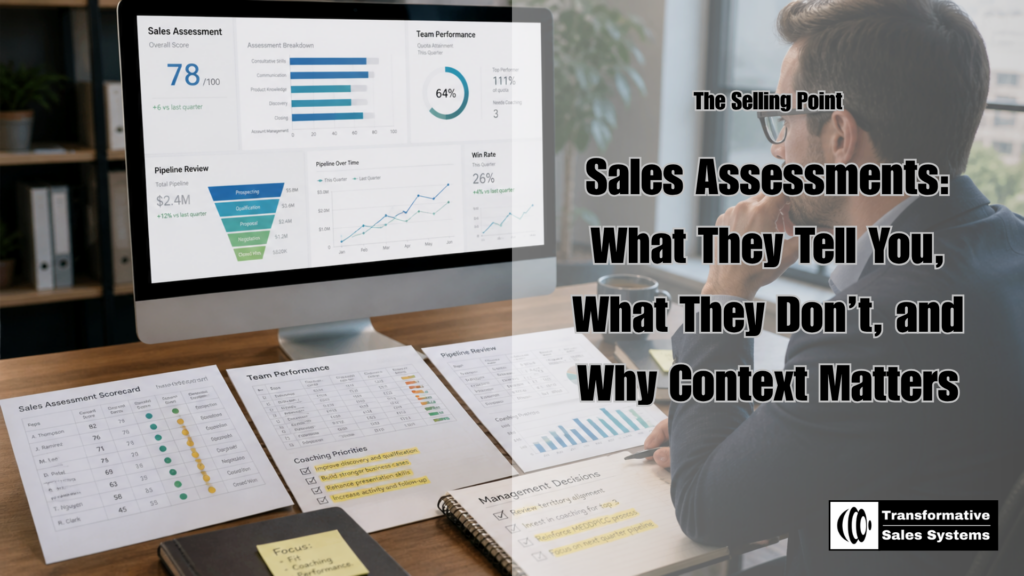
Sales assessments can be incredibly useful. They can help a business owner, CEO, or sales leader better understand how a salesperson communicates, what motivates them, how they respond under pressure, whether they appear to be wired for a certain type of sales role, and where they may struggle in the sales process.
That is valuable information. But it is not the whole answer.
This is where many companies get themselves into trouble. They take one assessment report, treat it like the final word, and then make major decisions about hiring, coaching, compensation, territory assignments, role design, or performance without fully understanding what the assessment was actually built to measure.
That is a mistake. Not because sales assessments are bad. They are not. When used properly, sales assessments can give leaders insight they would not otherwise see. The problem is assuming all assessments answer the same question.
They do not.
A behavioral assessment, a motivational assessment, a sales capability assessment, and a culture-fit or work-style assessment may all provide useful information. But each one looks at the salesperson through a different lens. If you do not understand the lens, you can easily draw the wrong conclusion.
Why Companies Use Sales Assessments
Most business owners and sales leaders turn to sales assessments because they are looking for clarity. They may be trying to determine whether a salesperson is a good fit, why someone is underperforming, whether a candidate can actually sell, or whether a team member is better suited for hunting new business or managing existing accounts.
They may also be trying to understand how to coach someone more effectively. Is the issue skill? Motivation? Behavior? Role fit? Management? Process? Those are all legitimate questions. The challenge is that no single assessment answers all of them equally well.
That is where context matters. A sales assessment can provide a helpful data point, but it should not be treated as the entire diagnosis. It is one piece of a larger sales management conversation.
Think of it this way. If your car is not running well, you do not want a mechanic to only check the tires. The tires may matter, but they are not the whole vehicle. You need to inspect the engine, fuel system, electronics, alignment, brakes, and how the car is actually performing on the road.
Sales assessments work the same way. They can reveal important information, but they do not explain everything by themselves.
Behavioral Assessments: How Someone Is Likely to Act
Behavioral assessments are often used to understand how a person tends to communicate, respond to problems, interact with others, deal with pace, and handle rules or structure. In a sales environment, that can be very helpful.
A behavioral assessment may show that a salesperson is highly persuasive, outgoing, fast-paced, competitive, cautious, methodical, detail-oriented, steady, independent, or resistant to structure. That helps a manager better understand how the person may show up in sales conversations, team meetings, prospecting activity, follow-up discipline, and internal communication.
For example, a salesperson with a highly outgoing and persuasive behavioral style may be very comfortable starting conversations, networking, presenting, and building quick rapport. That can be a real advantage in sales. But that same person may also talk too much, listen too little, skip over details, or move too quickly to presentation before fully understanding the prospect’s problem.
That does not mean the person cannot sell. It means the manager needs to understand the behavior and coach accordingly.
The strength of behavioral assessments is that they are usually easy to understand and practical for day-to-day management. They can help sales managers communicate more effectively with each salesperson. They can also explain why two people in the same role may approach the job very differently.
Behavioral assessments are useful for improving coaching, reducing communication friction, understanding team dynamics, and identifying potential blind spots in how a salesperson interacts with prospects and co-workers. In small and midsize businesses, they can be especially helpful because many sales managers are not trained managers. They often manage based on instinct. Behavioral data can give them a better starting point.
The limitation is that behavior does not prove sales ability.
A person may look like a “natural salesperson” because they are confident, verbal, persuasive, and comfortable with people. But that does not mean they can qualify opportunities, ask difficult questions, discuss money, uncover decision criteria, handle objections, or maintain pipeline discipline.
This is where business owners often get fooled. Charisma is not the same thing as sales effectiveness. A behavioral assessment may tell you how someone is likely to act. It may not tell you whether they can consistently create revenue in your specific sales environment.
That distinction matters.
Motivational Assessments: Why Someone Does What They Do
Motivational assessments, sometimes called driving-force assessments, are designed to help leaders understand what energizes a person. They may identify whether someone is driven by achievement, recognition, money, autonomy, learning, helping others, status, collaboration, structure, new ideas, or practical results.
This can be extremely useful in sales management because two salespeople can have similar behavioral styles but very different motivations. One may want public recognition. Another may want financial upside. Another may want freedom. Another may want stability. Another may want to be seen as an expert.
If a manager understands what motivates a salesperson, they can lead more effectively.
A salesperson who is motivated by recognition may respond well to public praise, leaderboard visibility, and opportunities to be seen as a top performer. A salesperson motivated by autonomy may perform best when given clear goals but flexibility in how to achieve them. A salesperson motivated by learning may respond well to technical training, product depth, industry expertise, and consultative selling opportunities.
The strength of motivational assessments is that they can improve coaching, retention, role design, and employee engagement. They can also help explain why a salesperson may be technically capable but still disengaged in a certain role or environment.
That matters because sales performance is not only about ability. Motivation matters. If the role drains the person, performance usually suffers.
The limitation is that motivation does not equal capability.
A salesperson may be highly motivated to win and still be weak at prospecting. They may want recognition but avoid tough conversations. They may want financial success but lack the discipline to follow up consistently. They may want autonomy but struggle without structure.
Motivation tells you what fuels the person. It does not tell you whether the engine is strong enough, tuned correctly, or being pointed in the right direction. A motivational assessment should help you manage and engage the salesperson. It should not be used by itself to determine whether that person can sell.
Sales Capability Assessments: Can This Person Actually Sell?
Sales capability assessments are more directly tied to sales performance. These assessments are usually designed to evaluate whether a salesperson has the strengths, weaknesses, skills, and sales DNA needed to succeed in a particular sales role.
They may examine areas such as prospecting, hunting, consultative selling, qualifying, asking difficult questions, reaching decision makers, discussing money, presenting value, handling objections, recovering from rejection, following a sales process, and closing.
This is where sales assessments can become much more predictive and useful for hiring, coaching, and development. A sales capability assessment may uncover issues that are not obvious in an interview or in casual observation.
A salesperson may appear confident and experienced but struggle with money conversations. Another may be great at relationship building but unable to challenge a prospect. Another may have years of experience but still avoid prospecting. Another may be likeable and polished but emotionally involved when a prospect pushes back.
Those issues matter because they directly affect revenue.
The strength of sales capability assessments is that they help separate sales personality from sales ability. That is a big deal.
Many business owners have hired a salesperson who interviewed well, sounded great, had industry experience, and seemed confident, only to find out later that the person could not create opportunities, qualify properly, or close profitable business.
A sales capability assessment helps reduce that risk. It can also give a manager a clearer coaching roadmap. Instead of saying, “You need to sell better,” the manager can focus on the specific constraint. The issue may be weak questioning. It may be need for approval. It may be discomfort discussing budget. It may be poor recovery from rejection. It may be lack of commitment. It may be a failure to follow the sales process.
The more specific the diagnosis, the better the coaching.
The downside is that these assessments can feel more direct. They may expose weaknesses that the salesperson or leader does not want to see. They also require interpretation.
Knowing that a salesperson struggles with qualification is helpful. But the real value comes from understanding how that weakness shows up in the business. Does it create bloated pipeline? Does it lead to too many quotes? Does it result in discounting? Does it cause long sales cycles? Does it make forecasting unreliable? Does it waste technical or estimating resources?
A sales capability assessment identifies potential issues. Sales leadership has to connect those issues to real sales behavior, CRM data, pipeline quality, and business results. Without that context, the assessment may become another report that gets read once and then filed away.
Culture-Fit and Work-Style Assessments: Is This Person in the Right Seat?
Culture-fit or work-style assessments are often used to understand how someone is wired to work. These tools can help identify whether someone is better suited for new business development, account management, customer service, sales engineering, technical sales, project management, inside sales, or sales leadership.
That is highly useful because many companies have people in the wrong seats.
This is especially common in small and midsize businesses. A strong relationship manager may be expected to hunt new business. A technical salesperson may be expected to prospect aggressively. A high-autonomy hunter may be buried in service work. A detail-oriented account manager may be pushed into a high-risk, high-rejection prospecting role.
When people are in the wrong seat, everyone gets frustrated. The salesperson feels like they are failing. The manager thinks the person is not trying. The owner wonders why the sales team is not producing.
Sometimes the issue is not effort. It is fit.
The strength of culture-fit and work-style assessments is that they are useful for role clarity, team design, communication, and management style. They can help a leader understand how to structure the team. Who should hunt? Who should manage existing accounts? Who should support technical conversations? Who should handle follow-up? Who needs structure? Who needs autonomy? Who can lead? Who needs to be managed closely?
That is valuable information. When used properly, work-style assessments help leaders stop forcing everyone into the same mold.
The limitation is that work style does not equal sales skill. Someone may be behaviorally suited for a sales role and still lack the competencies to perform. Another person may not look like the stereotypical salesperson but may be highly effective in a technical, consultative, relationship-driven environment.
These assessments can also be misused when leaders treat them as a shortcut for hiring decisions. A profile should not replace a proper interview process, reference checks, sales-specific evaluation, role clarity, and management judgment.
Culture fit matters. But it is not the whole answer.
The Biggest Mistake: Using the Right Assessment the Wrong Way
Most assessment problems are not caused by the tool itself. They are caused by how the tool is used.
A behavioral assessment should not be used as the sole basis for hiring a salesperson. A motivational assessment should not be used to determine whether someone can prospect. A sales capability assessment should not be interpreted without understanding the company’s sales process. A culture-fit assessment should not be used to excuse poor performance.
Each assessment has a job. The leader’s responsibility is to understand what job that assessment is doing.
Before using any sales assessment, the first question should be, “What decision am I trying to make?”
Are you trying to hire? Coach? Promote? Reassign accounts? Improve retention? Diagnose underperformance? Design the sales team? Evaluate sales leadership? Understand pipeline quality? Build a sales process?
Different questions require different data.
Assessment Data Needs Sales Management Context
This is where many companies fall short. They complete the assessment, review the report, discuss the findings, and then move on.
Nothing changes. No role changes. No coaching plan. No sales process improvement. No CRM cleanup. No pipeline review. No accountability cadence. No measurable next steps.
That is not a problem with the assessment. That is a problem with management execution.
Assessment data becomes valuable when it is connected to the rest of the sales organization.
If an assessment shows that a salesperson struggles with qualification, the next step should not be to simply say, “You need to qualify better.”
The better questions are: What does qualification mean in our sales process? Do we have defined exit criteria for each stage? Are we allowing weak opportunities to advance? Does the CRM capture decision criteria, budget, timeline, stakeholders, and next steps? Is the manager reviewing qualification during one-on-ones? Are proposals being issued too early? Is the pipeline inflated because opportunities are not being challenged?
That is how assessment data becomes actionable. The assessment points to a potential issue. Sales management turns it into better process, better coaching, and better execution.
A Few Practical Examples
Imagine a salesperson who scores high in influence, confidence, and communication. On paper, they look like a classic salesperson. They are outgoing, persuasive, energetic, and comfortable talking with prospects.
But when you inspect their pipeline, you may see something different. Lots of conversations. Lots of proposals. Lots of positive feedback. Not enough closed business.
The issue may not be effort. It may be qualification. They may be talking too much, listening too little, jumping to presentation, avoiding difficult questions, and keeping weak deals alive because the conversations feel good.
That person does not need another personality label. They need better discovery coaching, tighter qualification rules, stronger stage discipline, and accountability around next steps.
Now consider the opposite situation. A salesperson may not look flashy. They may be quieter, more methodical, more analytical, and less naturally outgoing. A business owner may assume they are not strong enough for sales.
But in a technical, consultative, relationship-based sales environment, that person may outperform the more charismatic seller because they prepare better, listen better, document better, follow up more consistently, and build trust with detail-oriented buyers.
That is why context matters. The best salesperson is not always the loudest person in the room. The best salesperson is the one whose skills, behavior, motivation, role, process, and market fit together.
Sometimes the Salesperson Is Not the Real Problem
This is the part many leaders miss.
A company may assess every salesperson and discover individual strengths and weaknesses. That can be helpful. But the bigger problem may not be the individual salespeople.
The real issue may be that the company has no defined sales process. Or no consistent sales meetings. Or no one-on-one coaching cadence. Or no CRM discipline. Or no agreement on what a qualified opportunity actually means.
In that case, the assessments are useful, but they are not the root cause. The sales operating system is the root cause.
If the company has no structure, even talented salespeople will be inconsistent. If the CRM is poorly used, the pipeline will be unreliable. If managers are not coaching, weaknesses will not improve. If proposals are issued before qualification, the team will waste time. If no one defines what “good” looks like, everyone will operate from their own interpretation.
A sales assessment can reveal the people issues. But leadership still has to fix the system.
How Sales Leaders Should Use Assessments
Sales assessments should be used as part of a broader management process. Start by clarifying the business question.
If you are hiring, use assessments to reduce risk, but do not skip interviews, role scorecards, reference checks, and real sales scenario discussions. If you are coaching, use assessments to identify specific development areas, then turn those into observable behaviors. If you are evaluating the team, combine assessment data with CRM behavior, pipeline movement, sales results, activity quality, close rates, sales cycle length, and manager observations.
If you are considering role changes, use assessment data to determine whether the issue is skill, will, fit, structure, or leadership. If you are trying to improve revenue, do not stop at the individual. Look at the entire sales system.
The best use of assessments is not to label people. The best use of assessments is to make better management decisions.
What Sales Assessments Can and Cannot Tell You
Sales assessments can help leaders understand how someone communicates, what motivates them, how they respond to pressure, whether they appear to fit a role, where they may struggle in the sales process, what coaching may be needed, whether a candidate has potential risk factors, how a team may need to be structured, and where management may need to adapt.
That is all valuable.
But sales assessments cannot replace leadership. They cannot fix a broken sales process. They cannot clean up a weak pipeline. They cannot coach the team. They cannot create accountability. They cannot make a bad hire good. They cannot turn unclear expectations into clear ones. They cannot determine strategy. They cannot manage performance.
They provide insight.
Leadership has to turn that insight into action.
The Bottom Line
Sales assessments are valuable when they are used properly. They can help business owners, CEOs, and sales leaders see things that are easy to miss. They can improve hiring, coaching, role design, communication, retention, and performance management.
But assessments are not magic. They are tools. And like any tool, their value depends on how they are used.
The real value comes when assessment data is interpreted in context with sales process, CRM behavior, pipeline quality, coaching cadence, role clarity, and revenue goals.
A sales assessment can tell you a lot. But it should never be the end of the conversation.
It should be the beginning of a better one.
Sales Assessments FAQ’s
What are sales assessments?
Sales assessments are tools used to evaluate different aspects of a salesperson or sales candidate. Depending on the assessment, they may measure behavior, motivation, work style, role fit, sales capabilities, or specific selling weaknesses.
Are sales assessments useful for hiring salespeople?
Yes, sales assessments can be very useful in hiring, but they should not be the only factor. They work best when combined with a clear role scorecard, structured interviews, reference checks, and a realistic understanding of the company’s sales environment.
What is the difference between a sales personality assessment and a sales capability assessment?
A sales personality or behavioral assessment usually describes how someone is likely to communicate, behave, and interact with others. A sales capability assessment is more focused on whether the person can actually perform specific sales functions such as prospecting, qualifying, consultative selling, handling objections, and closing.
Can a behavioral assessment predict sales success?
Not by itself. Behavioral assessments can identify useful tendencies and potential coaching needs, but they do not prove that someone has the skills, discipline, or sales DNA needed to succeed in a specific sales role.
What is the biggest mistake companies make with sales assessments?
The biggest mistake is treating one assessment as the complete answer. Sales assessments should be used as inputs, not final conclusions. They need to be interpreted alongside sales process, CRM behavior, pipeline quality, management practices, and actual performance.
How should sales leaders use assessment results?
Sales leaders should use assessment results to make better management decisions. That may include improving coaching, clarifying roles, adjusting expectations, identifying skill gaps, improving the sales process, or determining whether someone is in the right seat.
Can sales assessments fix sales performance problems?
No. Sales assessments can identify possible issues, but they do not fix them. Sales performance improves when leaders turn assessment insights into coaching, process improvement, accountability, and better execution.
Transformative Sales Systems
812-924-7085
Schedule a 30 minute meeting: https://calendly.com/anthony-nicks/30min
Learn more about Fractional Sales Management at https://transformativesalessystems.com/sales-leadership/
Read more about Fractional Sales Management: https://www.amazon.com/dp/B0FLWSXX5D