
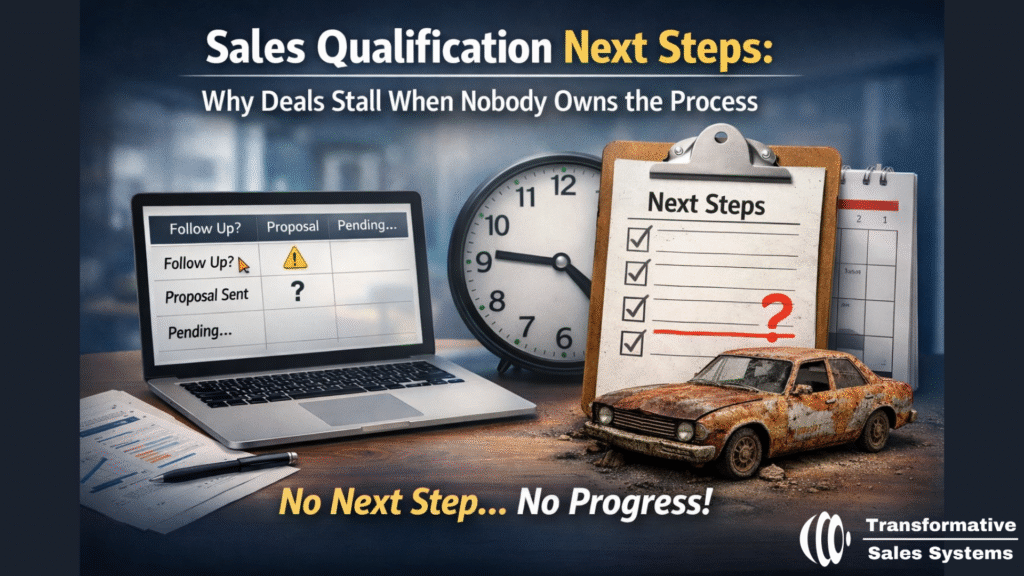
If you want to know why so many SMB deals stall after “good” conversations, it usually comes down to one thing: nobody owns the next step. The prospect is interested, the salesperson feels optimistic, and the opportunity gets advanced. Then the deal just sits there while everyone waits for the buyer to magically reappear with a decision.
That is not a sales problem. That is a process ownership problem, and it directly impacts sales qualification next steps.
In a healthy sales process, next steps are not suggestions. They are commitments. They are clear, scheduled, and tied to a decision path. When next steps are vague, the deal is not qualified, no matter how friendly the buyer is or how much they like your solution.
This article breaks down why weak next-step ownership inflates pipelines, kills velocity, and turns “follow-up” into a lifestyle. More importantly, it shows how to turn sales qualification next steps into a real standard your team can execute and leadership can enforce.
What sales qualification next steps actually mean
Sales qualification next steps are the mutually agreed actions that move a deal forward, with an owner and a date. They are not “I’ll check back” or “send me something” or “we’ll talk internally.” Those are vague intentions, not commitments.
A qualified opportunity requires a next step that is clear enough to answer three questions: what happens next, who is involved, and when it will occur. If you cannot answer those questions, you are not in a sales cycle. You are in a waiting room.
This is where many SMB sales teams get themselves in trouble. They confuse activity with progress and optimism with qualification. They leave calls without a firm next step, but they still advance the deal because the prospect sounded positive. That creates a pipeline full of deals that are technically alive but practically dormant.
Why deals stall even when the prospect likes you
Many CEOs assume deals stall because the salesperson didn’t follow up enough. Sometimes that’s true, but more often the root cause is earlier and more structural.
Deals stall because the prospect never committed to a decision process. Deals stall because the salesperson did not earn the right to ask for a scheduled next step. Deals stall because the buyer’s urgency is unclear, the decision criteria are vague, or the rep is trying to avoid uncomfortable questions.
When the buyer’s world is unclear, “follow up” becomes the default. And follow up is what salespeople do when they have no leverage in the deal.
Strong sales qualification next steps remove ambiguity. They make the buyer’s decision path visible and measurable. They turn the sales cycle into something you can manage instead of something you hope goes your way.
The most expensive phrase in SMB sales: “Just send me something”
If there is one phrase that creates more stalled deals than almost any other, it’s “Just send me something.”
Reps hear that and think it’s progress. Prospects say it because it feels like a step without commitment. The rep sends a PDF, a deck, a quote, or a proposal and then… silence. Now the rep is stuck sending “just checking in” messages, and the CEO is stuck staring at an opportunity that looks late stage but isn’t moving.
Here’s the truth: “Send me something” is not a next step. It is a stall disguised as momentum.
The fix is simple and it’s a standard: information is fine, but it must be tied to a scheduled decision-related conversation. If the prospect is not willing to schedule the next conversation, you do not have a qualified opportunity. You have a polite request for free work.
Why proposals are where deals go to die
In SMB sales, proposals are often treated like the finish line. In reality, proposals are where weak process ownership gets exposed.
If your team sends proposals without a scheduled review meeting, you are giving away control. You are letting the prospect define the timeline, define the evaluation process, and define the next steps. That is why proposals get ghosted. It is not always that the buyer is dishonest. It is that they were never committed to a decision path.
A proposal should support a decision. It should not replace a decision process. If a proposal goes out without a clear review meeting and a defined “what happens after” plan, it is not a late-stage deal. It is a document floating in someone’s inbox.
A strong rule is this: no proposal is sent unless the proposal review meeting is on the calendar. That meeting should include the right stakeholders, a clear agenda, and a decision timeline. If you cannot get that, the deal is not qualified.
Sales qualification next steps require mutual agreement, not salesperson effort
A common mistake is thinking next steps are about follow-up discipline. Follow-up matters, but effort cannot substitute for commitment. A rep can follow up ten times and still not move the deal forward if there is no mutual agreement on what happens next.
Mutual agreement is the difference between selling and chasing. It is also the difference between a deal you can forecast and a deal you cannot.
Sales qualification next steps are not “I will email you.” They are “We will meet on Thursday at 2:00 with you and your operations lead to review the options and confirm the selection criteria.”
That level of specificity is what turns a conversation into a sales cycle.
What strong next steps look like in the real world
Next steps should be framed around decisions and progress, not tasks.
A strong next step might be a working session to quantify impact, a stakeholder alignment call, a technical review, a proposal review, a reference call, or an implementation planning discussion. The point is that the next step should advance the buyer’s decision, not simply keep the salesperson busy.
Strong next steps also have a clear purpose. If your rep cannot explain why the meeting exists and what outcome it needs to produce, you are scheduling activity, not progress.
This is one of the fastest ways to tighten pipeline health: require purpose, participants, and a date for every next step, and make stage advancement dependent on it.
The CEO move: change the standard from “follow up” to “calendar”
If you want to improve close rates and velocity quickly, you don’t need a complicated system. You need a simple standard: no next step, no stage advancement.
When a rep says, “They want to think about it,” your question is: “What exactly are they deciding, and when are we meeting to review it?”
When a rep says, “I sent the proposal,” your question is: “When is the review meeting and who will attend?”
When a rep says, “I’m following up,” your question is: “Following up for what decision, and what is our agreed next step?”
This is not micromanagement. It is process clarity. It forces the team to stop treating hope like a strategy.
The minute you install this standard, you will see your pipeline become smaller but healthier. You will also see your reps become more deliberate, because they will learn quickly that vague deals don’t get attention. Real deals do.
Why this improves forecasting and reduces emotional pipeline
Many SMB pipelines are emotional. Deals are counted because they feel promising, not because they are defined. Next-step vagueness is the fuel that keeps emotional pipeline alive. It allows a deal to sit in “proposal” for 60 days while everyone pretends it’s still hot.
Sales qualification next steps remove emotion by adding structure. If the next step is not on the calendar, the deal is not progressing. If it is not progressing, it should not be forecasted the same way as a deal with scheduled milestones.
This is where forecasting accuracy improves dramatically. Your stages start to mean something. Your CRM starts reflecting reality. Your sales meetings become coaching conversations instead of status updates.
Where fractional sales management fits
This standard is simple on paper. It is hard in real life without leadership.
A process does not enforce itself. Salespeople will drift back into old habits, especially when they are busy or uncomfortable. That’s why Fractional Sales Management works in SMBs. Someone has to own the process, coach the behaviors, and reinforce the standards weekly until they become normal.
Sales qualification next steps are a leadership lever. They tighten the pipeline, increase velocity, reduce ghosting, and create a sales cadence that produces predictable revenue instead of unpredictable hope.
If deals keep stalling in your business, don’t start by blaming follow-up. Start by installing ownership. Define what a qualified next step is, make it non-negotiable, and coach the team to earn commitments instead of chasing maybes.
Bottom line
Deals stall when nobody owns the process. Vague next steps create pipeline bloat, kill close rates, and turn forecasting into guesswork.
Sales qualification next steps must be mutually agreed, specific, scheduled, and tied to a decision path. If the next step isn’t clear enough to put on the calendar with the right people, the deal isn’t qualified, and it shouldn’t be advanced.
FAQ’s
What are sales qualification next steps?
Sales qualification next steps are the mutually agreed actions that move a deal forward, including what will happen next, who will be involved, and when it will occur. They must be specific and scheduled, not vague follow-up intentions.
Why do deals stall after a good sales call?
Deals often stall because the next step was never owned. If the buyer did not commit to a decision-related meeting with a timeline, the salesperson is left chasing without leverage.
Should you send a proposal without a scheduled review meeting?
In most cases, no. Sending proposals without a review meeting removes deal control, increases ghosting, and often turns the deal into a price comparison. A review meeting should be on the calendar before the proposal is sent.
What does “no next step, no stage advancement” mean?
It means an opportunity cannot move forward in the CRM unless there is a mutually agreed next step scheduled. This prevents pipeline inflation and keeps stages tied to real progress.
How do sales qualification next steps improve forecasting?
When next steps are scheduled and tied to milestones, pipeline stages reflect reality. This reduces late-stage deals that linger without movement and makes forecasts more accurate.
What is the fastest way for a CEO to fix stalled deals?
Define a qualified next step standard, require calendar commitments for stage advancement, and enforce it weekly in deal reviews. This creates ownership and reduces pipeline drift.
Transformative Sales Systems
812-924-7085
Schedule a 30 minute meeting: https://calendly.com/anthony-nicks/30min
Learn more about Fractional Sales Management at https://transformativesalessystems.com/sales-leadership/
Read more about Fractional Sales Management: https://www.amazon.com/dp/B0FLWSXX5D