
By Anthony R. Nicks | Founder and CEO, Transformative Sales Systems
“We lost on price.”
That may be true. It is not enough information to decide whether your company should lower its prices, change its proposal, improve discovery, or stop pursuing that type of customer.
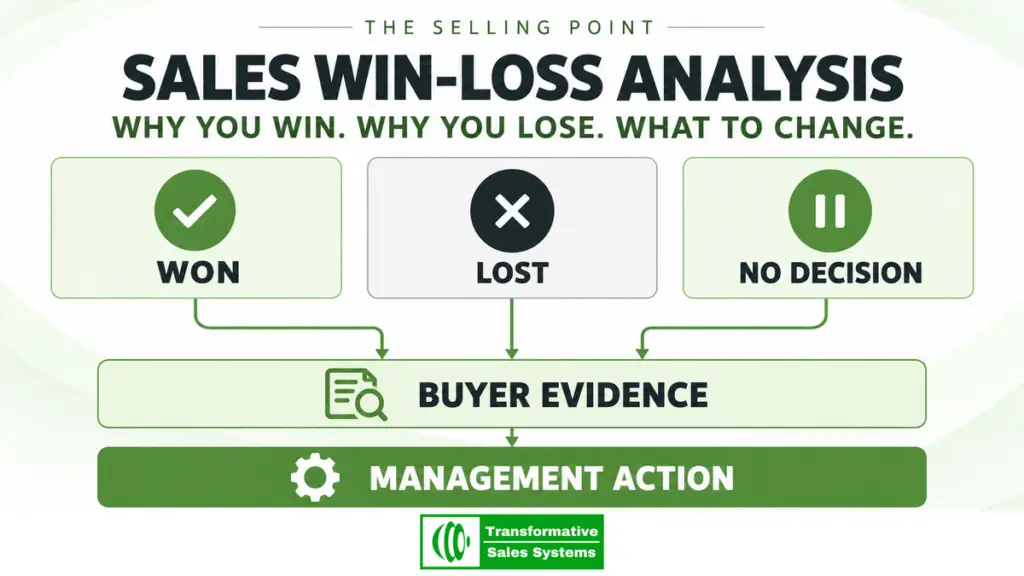
Sales win-loss analysis should help you make those decisions. It examines completed opportunities to understand what influenced the buyer and what your business should do differently.
For CEOs and owners, this is more than a sales reporting exercise. The findings may affect where you invest, which customers you pursue, how you allocate technical resources, and what work you accept. For sales leaders, they should provide direction for qualification, coaching, and deal strategy.
Our recent articles on sales pipeline reviews and sales forecast accuracy focused on evaluating open opportunities. The recovery-plan article addressed what to do when the expected result falls short.
Now we need to close the learning loop: after an opportunity ends, what changes before the next one begins?
What is sales win-loss analysis?
Sales win-loss analysis is a structured review of completed buying decisions. It combines buyer feedback with opportunity records and the salesperson’s perspective to investigate why the customer bought from you, selected an alternative, or decided not to proceed.
The buyer’s perspective is central. Pragmatic Institute describes win-loss analysis as understanding the buying process from that perspective—not simply collecting internal explanations. Source: Pragmatic Institute
I would judge the process by the decisions it produces. A better reason code in the CRM is useful. A supported change to qualification, proposal development, or management support is more useful.
Here is a seven-step approach I recommend for a small or midsize B2B company.
1. Define the outcomes before comparing results
Start by agreeing on what each outcome means.
Won: The customer made a commitment that satisfies your company’s standard for booked business. A favorable conversation does not count as an order.
Lost to an alternative: The customer confirmed that the business went elsewhere. Record the selected alternative when known. Do not fill in a competitor’s name because someone suspects it.
No decision: The buying initiative ended without a purchase. The customer may have canceled the project, withdrawn funding, or chosen to continue with its current approach.
Disqualified: Your company determined that the opportunity did not meet its pursuit criteria. Keep these records available, but distinguish them from qualified opportunities that reached a buying outcome. Preserve when and why they were disqualified; do not relabel losses afterward to improve the report.
A delayed project is not automatically a no-decision outcome. A buyer who stops answering has not necessarily chosen a competitor. Keep unknown outcomes identifiable rather than inventing certainty.
Next, define the group being reviewed. For example: qualified new-equipment opportunities with a confirmed outcome during the last quarter. Do not quietly mix renewals, service requests, and new capital projects into the same comparison.
Use one record per buying decision. Revised proposals are not additional opportunities unless they represent genuinely separate purchases.
2. Separate what you know from what you believe
The CRM gives you a starting point: customer, offering, value, decision date, salesperson, proposal history, and recorded outcome. Add the relevant conversations, decision criteria, and unresolved issues.
Then separate three kinds of information.
Buyer-reported information records what the customer said and who said it. Documented facts include agreed specifications, proposal dates, and written commitments. Internal interpretations describe what your team believes happened.
Those categories can support one another, but they are not interchangeable. Clozd’s guidance similarly distinguishes direct buyer feedback from the internal account of a deal. Source: Clozd
“The buyer said our delivery date missed its required installation window” is different from “We think delivery was the problem.” Both belong in the review, with their status clear.
A buyer’s explanation also has limits. One contact may not know everything discussed by purchasing, finance, or the final approver. Record the person’s role and any conflicting accounts.
When information is unavailable, write “not confirmed.” Do not make the salesperson select a convenient explanation just to complete a required field.
3. Ask the buyer about the decision—not your preferred explanation
I recommend requesting a brief conversation soon after the decision, while the buying process is still recent. Fifteen to twenty minutes is a reasonable starting request, not a requirement for every opportunity.
Make the purpose explicit: you want to understand the experience and improve. You are not calling to argue about the result or restart negotiations.
Where practical, use someone who did not own the deal. That might be another manager, a trained colleague, or an outside interviewer. The person needs enough business knowledge to ask useful follow-ups and enough distance to listen without defending the proposal.
Start broadly and follow the buyer’s answers. Clozd’s interview guidance recommends open-ended questions and adapting the conversation rather than working rigidly through a survey. Source: Clozd
Questions I would use include:
- What originally made this worth evaluating?
- What mattered most when you compared the available approaches?
- How was the decision made, and whose requirements influenced it?
- Where did our approach fit well, and where did it fall short?
- What made the final choice the right one for your business?
- What could we have clarified or handled differently?
When price comes up, explore the comparison. Was the issue affordability, payment terms, total cost, scope, or confidence that the proposed benefit justified the investment?
When the buyer says “relationship,” ask what that relationship made possible. Familiarity with the application? Faster problem resolution? Confidence in delivery? Access to someone who could resolve a technical concern?
Interview buyers who selected you as well as those who did not. Ask winning buyers what nearly prevented the purchase. The purpose is to understand both repeatable strengths and weaknesses that a win might conceal.
4. Compare similar opportunities and make the denominator visible
Look for recurring themes within a reasonably comparable group. Separate new customers from existing accounts where that distinction matters. Consider offering, application, deal size, customer type, and sales cycle before comparing salespeople.
Pragmatic Institute recommends organizing research around groups of buyers with shared characteristics. Otherwise, a collection of interesting stories can be mistaken for a meaningful pattern. Source: Pragmatic Institute
Here is a hypothetical example, not a client result or an industry benchmark.
A company reviews 20 qualified equipment opportunities with confirmed outcomes during a quarter. It won six, lost four to other suppliers, and recorded ten no-decision outcomes.
Among opportunities that resulted in a purchase, its win rate was 60%: six wins divided by ten purchase decisions.
Across all 20 completed opportunities, the share won was 30%: six divided by twenty. The no-decision share was 50%: ten divided by twenty.
None of those calculations is wrong. They answer different questions.
If leadership sees only the 60% figure, it may focus on beating competitors while overlooking the ten buying initiatives that ended without an order for anyone. Those outcomes deserve investigation into qualification, business priority, funding, and the buying process—not an automatic conclusion that the salespeople failed to create urgency.
Label each measure and show its underlying counts. These are closed-opportunity results, not the eventual conversion rate of every opportunity created that quarter.
For interview findings, show how many buyers responded and which outcomes they represent. Three interviews do not establish what the entire market believes. Repeated observations may justify a focused experiment without proving a universal cause.
5. Test the explanation before changing the business
Continue the hypothetical equipment example.
Suppose the sales team coded three competitive losses as “price.” Two of those buyers agree to a follow-up conversation.
The first says it chose a higher-priced supplier because that supplier provided a clearer installation plan. The second says the quotations were similar, but the selected supplier could meet a required delivery date. The third buyer does not respond.
The appropriate conclusion is not that price never matters. It is that the available evidence does not support a blanket price reduction as the response to these three losses.
For the first opportunity, review how installation responsibilities and risks were explained. For the second, examine whether the required date was understood early enough and whether the company could realistically meet it. The third explanation remains unconfirmed.
Now review the wins with the same discipline. Did the customer value a capability you can consistently provide? Did an early technical discussion resolve a concern? Did the order require an exception that would be difficult to repeat?
For an owner, “we won” is not the end of the review. Examine the approved margin, scope, delivery commitments, and unusual concessions. Later, compare actual delivery economics separately; those results should not be rewritten as things the buyer or salesperson necessarily knew at the decision date.
Some findings should lead to better selling. Others should lead to operational decisions, a different target market, or a decision not to pursue certain work.
Do not assign the sales manager a coaching problem when leadership needs to make a capacity decision.
6. Turn sales win-loss analysis into assigned management action
Choose a small number of supported findings and decide what to change. Avoid issuing ten new rules after one review.
Each action needs an owner, a due date, and evidence that will show whether it was implemented. It also needs a later check on whether the change helped.
The table below illustrates how to make that connection. These are possible responses to verified findings, not prescriptions for every company.
| Finding | Management action | Owner | Evidence to review |
| Buyers could not distinguish included work from exclusions. | Revise the proposal and confirm scope with the buyer before submission. | Sales leader and estimating lead | Revised proposal; buyer’s confirmation or remaining questions |
| Required delivery dates were discovered too late. | Confirm timing earlier and add a capacity review before promising a date. | Sales leader and operations lead | Recorded requirement; capacity decision; approved commitment |
| Approval requirements were repeatedly missing. | Coach discovery of the buying process and review that evidence before forecasting. | Sales manager | Buyer-confirmed approval steps and unresolved conditions |
| Winning buyers valued early technical involvement. | Define which opportunities warrant technical support and test that approach. | Sales leader and technical lead | Support provided; buyer feedback; resource use and later outcomes |
Set an actual date for each action in your working record. “Ongoing” is not a useful deadline for implementing a change.
Use sales one-on-one meetings to develop the specific behavior involved. If the issue is clarifying the decision process, review an example, practice the questions, and examine what happens in the next buyer conversation.
Leadership must own its commitments too. A salesperson cannot resolve an unavailable production slot or an unanswered pricing exception by trying harder.
7. Build the review into your management cadence
For a small B2B team, I would start with a monthly review of recent outcomes and a quarterly assessment of broader patterns. Adjust the interval to your opportunity volume and sales cycle. A company closing three major projects a year needs a different approach from one completing dozens of transactions each month.
Capture the initial facts when the opportunity closes rather than reconstructing everything at quarter-end. Use the monthly discussion to review new evidence, choose actions, and check previous commitments.
The owner does not need to attend every interview. The owner does need to support honest findings and make decisions that cross departmental boundaries.
Keep the learning review distinct from a disciplinary conversation. Address repeated failure to meet an agreed standard when necessary, but do not treat every unfavorable outcome as evidence of poor performance.
At the next review, ask whether the chosen behavior or process actually changed. Did the team clarify scope earlier? Did operations provide the promised capacity decision? Did buyers understand the implementation plan?
Then watch commercial outcomes over an appropriate sales cycle. Compare similar opportunities and retain the counts. A better quarter does not, by itself, prove that one process change caused the improvement.
A practical win-loss review record
Keep the working record short enough that your team will use it. I would include these fields:
| Field | What to record |
| Opportunity and comparison group | Customer, offering, new or existing account, value basis, owner, and decision date |
| Outcome | Won, lost to an alternative, no decision, disqualified, or still unconfirmed |
| Buyer perspective | Contact and role, interview date, decision criteria, and reported reasons |
| Supporting evidence | Relevant records, proposal details, commitments, and conflicting information |
| What remains unknown | Unanswered questions and interpretations that have not been confirmed |
| Management response | Specific change or further investigation, accountable owner, and due date |
| Follow-through | Implementation evidence, outcome to watch, and next review date |
One opportunity can have several contributing factors. Record them without implying each factor independently caused the outcome. Keep sensitive buyer comments and personnel observations accessible only to the people who need them.
What CEOs and owners should expect
Ask your sales leader to bring more than a chart of won and lost business.
Expect a clear explanation of what was reviewed, which findings came from buyers, what remains uncertain, and which changes the team recommends. Expect to see what leadership must do—not just what salespeople must do.
You do not need a large research department to begin. Choose one business question, define a comparable group of opportunities, collect the evidence, and make one or two improvements you can review.
The value of sales win-loss analysis is not a more convincing explanation of last quarter. It is a better decision about what your business does next.
At Transformative Sales Systems, we help owners and sales leaders connect diagnosis, coaching, process improvement, and accountability. When the same sales problems keep returning, the next step is not another demand for better results. It is understanding what needs to change and putting the management system in place to change it.
Let’s discuss what your sales results are telling you—and what your team needs to do next.
Frequently asked questions about sales win-loss analysis
What should a sales win-loss analysis include?
Include the opportunity’s outcome, customer and offering, decision date, buyer-reported reasons, supporting records, unconfirmed assumptions, and proposed management response. Finish with an owner, a due date, and a review of what changed. Separate the buyer’s account from your team’s interpretation.
How is win-loss analysis different from a pipeline review?
A pipeline review evaluates open opportunities, buyer progress, next steps, and forecast evidence. Win-loss analysis examines completed buying decisions to identify lessons for future opportunities. The findings should inform pipeline standards without turning the two reviews into the same meeting.
Who should conduct win-loss interviews?
Use someone who can listen objectively, understand the business context, and ask open-ended follow-up questions. Where practical, choose someone other than the salesperson who owned the opportunity. A trained internal colleague or an outside interviewer can fill that role.
How many opportunities should we review?
Start with a manageable group of comparable opportunities and include different outcomes. There is no universal minimum that makes findings reliable. Show the number reviewed, the number of buyer responses, and the gaps. Treat a small pilot as a source of testable ideas, not a representative market survey.
Should no-decision opportunities count as losses?
Track them separately so leadership can distinguish losing to another supplier from a buying initiative ending without a purchase. You can include them in an overall closed-opportunity win rate, but label the denominator and also report the no-decision share. Keep unknown or genuinely delayed outcomes distinct.
How often should we conduct sales win-loss analysis?
Capture information as opportunities close. For a small B2B team, a monthly learning review and quarterly pattern review are useful starting points. Adjust the cadence to deal volume, decision timing, and the time needed to observe whether management actions are working.
Transformative Sales Systems
812-924-7085
Schedule a 30 minute meeting: https://calendly.com/anthony-nicks/30min
Learn more about Fractional Sales Management at https://transformativesalessystems.com/sales-leadership/
Read more about Fractional Sales Management: https://www.amazon.com/dp/B0FLWSXX5D