
If you lead a small or mid-sized business, you have probably felt this tension: your sales team keeps cutting price to win deals, while you keep wondering why profit margins are shrinking and the “big wins” never seem to show up on the bottom line.
That tension usually comes down to one thing: selling on price vs value.
On the surface, selling on price looks like a simple way to stay competitive. You shave a little off to get a yes. Your salesperson feels like a hero. The customer feels like they “won.”
But underneath, you just trained your market to see you as the cheaper option, not the better option. And that shift is expensive.
Selling on price is not a sales tactic. It is a slow bleed.
Price-Based Selling: What It Really Costs You
Let’s be blunt. When your company competes by selling on price vs value, you do not build a sales strategy. You build a coupon program.
Here is what that really costs you as a CEO.
1. Margin erosion that compounds
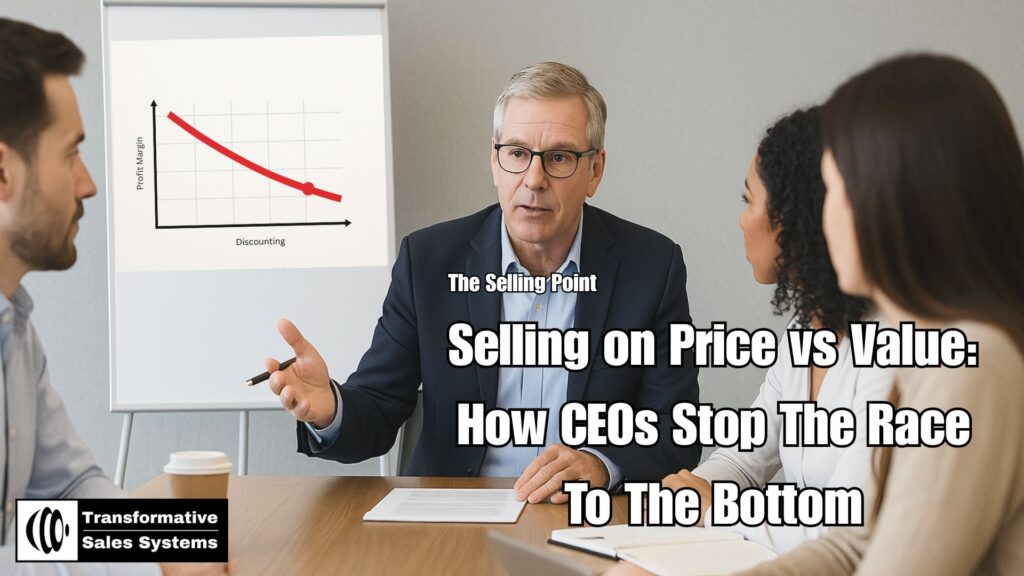
Most owners underestimate what a discount really does to profit. A 10 percent price cut on a product that has a 30 percent gross margin can wipe out a third or more of your profit on that deal.
Do that across a quarter and suddenly you are working harder to stand still. Revenue looks fine. Profit does not.
2. You attract the wrong customers
Price buyers behave differently than value buyers.
Price buyers are:
-
Quick to demand more for less
-
First to leave when someone else goes lower
-
Least loyal and most emotional when anything goes wrong
They are also the ones that beat up your team the most. You end up spending your energy on the least profitable accounts.
3. Your brand slides into “commodity” territory
If your team leads with price, your brand becomes “one of many” instead of “the one we want.” You are no longer evaluated on expertise, reliability, or long term impact. You are just a number in a spreadsheet.
Once your company is seen as a commodity, it is very hard to climb back out.
4. Sales behavior gets lazy
When salespeople learn that discounting closes deals, they stop doing the harder work:
-
Discovery
-
Qualification
-
Business conversations
-
Handling objections
-
Differentiating your solution
Why fight through a tough conversation when you can just drop the price and move on to the next quote? That mindset is death to a healthy sales culture.
Value-Based Selling: The Game You Actually Want To Play
If selling on price is a race to the bottom, selling on value is the exact opposite.
Value-based selling does not ignore price. It puts price in context.
Instead of “Can you do it cheaper?” the conversation becomes “Is this worth it to fix the problem the right way?”
When your team sells on value, they do three things consistently:
-
Clarify the business problem
They understand what is broken in the customer’s world and what it costs to leave it that way. -
Connect your solution to outcomes
They talk about downtime reduced, revenue gained, risk removed, efficiency improved. Real impact, not vague benefits. -
Position price against that impact
Price becomes an investment to achieve those outcomes, not just a line item to cut down.
This is where the right clients live. They are not looking for the cheapest. They are looking for the most effective and the most reliable. That is where your company should live too.
Why Your Team Keeps Falling Back To Price (And Why That Is On Leadership)
If you are honest, most of your salespeople already know they should sell on value. So why do they keep dropping price?
Because the system around them makes it easy.
-
No clear value story. They cannot easily explain what makes you different or why you are worth more.
-
No defined sales process. Every salesperson is winging it. When the conversation gets uncomfortable, they bail out with a discount.
-
No pricing guardrails. They are allowed to “get creative” on price without limits, so they do.
-
Comp plans that reward revenue, not margin. If they get paid on top-line only, they will do whatever it takes to get a yes, even if it destroys profitability.
-
No consistent coaching. Nobody is listening to calls, reviewing deals, or pushing them to stay in a value conversation when a buyer pushes for a discount.
That is not a salesperson problem. That is a sales leadership problem.
And in most SMBs, the “sales leader” is the CEO, whether they want that job or not.
How CEOs Shift From Selling on Price vs Value
You cannot fix this with a pep talk. You fix it by changing the system your salespeople operate in.
Here is where to start.
1. Define your value clearly
Your team should be able to answer, in simple language:
-
Why do good customers choose us and stay with us?
-
What problems do we solve that are painful and expensive for them?
-
What do they gain by working with us that they cannot get from a cheaper option?
If you have not taken time to define this, your team is guessing. Guessing leads to price.
2. Design your sales process around value, not quotes
A healthy process forces value conversations before price conversations.
For example:
-
Discovery: understand the business problem and impact
-
Fit: confirm you can actually help
-
Value: align on outcomes and expectations
-
Proposal: present approach, investment, and expected results
-
Review: handle objections and confirm next steps
If your process is “send a quote and hope,” you have already chosen price over value.
3. Put real guardrails around discounting
Every company needs rules here. Examples:
-
Minimum margin thresholds
-
Pre-approval for discounts above a certain level
-
Specific situations where discounting is allowed (volume, strategic account, pilot agreement), with reasons documented
Guardrails do not kill deals. They protect your profit and your brand.
4. Change what you reward
If you only celebrate big revenue numbers, do not be surprised when your team closes bad deals.
Start tracking and rewarding:
-
Margin quality
-
Deal quality (ideal client fit)
-
Multi-year agreements
-
Expansion inside healthy accounts
Salespeople pay attention to what leadership praises and pays for. If you say “sell on value” but pay on volume alone, they believe your compensation plan, not your words.
5. Provide real sales leadership, not drive-by feedback
Your sales team needs active coaching:
-
Deal reviews that challenge discounts
-
Call listening and feedback
-
Role plays around value conversations
-
Ongoing clarity on where the company is going and what kind of customers you want
That is hard to do when you also wear the CEO, COO, or owner hat. Which brings us to the role of Fractional Sales Management.
Where Fractional Sales Management Fits In
Most owners I talk to already know that selling on price vs value is a problem in their business. They just do not have the time, structure, or expertise to rebuild their sales approach while also running the rest of the company.
That is where Fractional Sales Management becomes a practical option.
A fractional sales leader steps in as your part-time VP of Sales and helps you:
-
Diagnose where your team is defaulting to price
-
Clarify and document your value story
-
Build or refine a real sales process
-
Set pricing and discounting guardrails
-
Coach your salespeople on value-based selling
-
Install the metrics and meeting rhythm to keep it all moving
You keep control of your strategy. You keep your team. You get sales leadership that focuses on value, margin, and predictable growth instead of reactive discounting.
Fractional Sales Management is not another “training event.” It is ongoing leadership that makes sure the work actually gets done and sticks.
Final Thought: You Get To Decide What You Compete On
As a CEO or owner, you get to decide what game your company plays.
If you choose selling on price, the rules are simple:
-
Someone will always go lower
-
You will have to work harder for less profit
-
You will attract customers who treat you like a vendor, not a partner
If you choose selling on value, the rules change:
-
You compete on outcomes, reliability, and expertise
-
You protect your margins and your brand
-
You attract customers who want a long-term relationship, not a one-time bargain
You do not fix this with a cheaper quote. You fix it with leadership, process, and a clear commitment to value.
If you want a sales team that sells on value, not price, the next move is yours.
FAQ Section
Q1: What does selling on price vs value really mean?
Selling on price vs value is the difference between competing as the cheapest option and winning deals because of outcomes, reliability, and long-term impact. Price-only selling turns you into a commodity. Value-based selling positions you as a partner.
Q2: Why is selling on price dangerous for small and mid-sized businesses?
For SMBs, discounting quickly erodes profit margins, attracts high-maintenance low-margin customers, and makes it harder to invest in growth. It feels like a quick win but creates long-term damage.
Q3: How can I help my sales team sell on value instead of dropping price?
Give them a clear value story, a defined sales process, pricing guardrails, and real coaching. They need to know what makes you different and have permission to hold the line on price.
Q4: Where does fractional sales management help with selling on price vs value?
A fractional sales manager acts like a part-time VP of Sales. They build the process, train the team, set pricing discipline, and coach reps to sell on value so you are not the only one pushing it as the CEO.
Q5: Can we ever discount and still be value-based?
Yes, as long as discounting is intentional, limited, and tied to a clear strategy. The problem is not the occasional discount. The problem is when discounting becomes the default way to close deals.
Transformative Sales Systems
812-924-7085
Schedule a 30 minute meeting: https://calendly.com/anthony-nicks/30min
Learn more about Fractional Sales Management at https://transformativesalessystems.com/sales-leadership/
Read more about Fractional Sales Management: https://www.amazon.com/dp/B0FLWSXX5D