
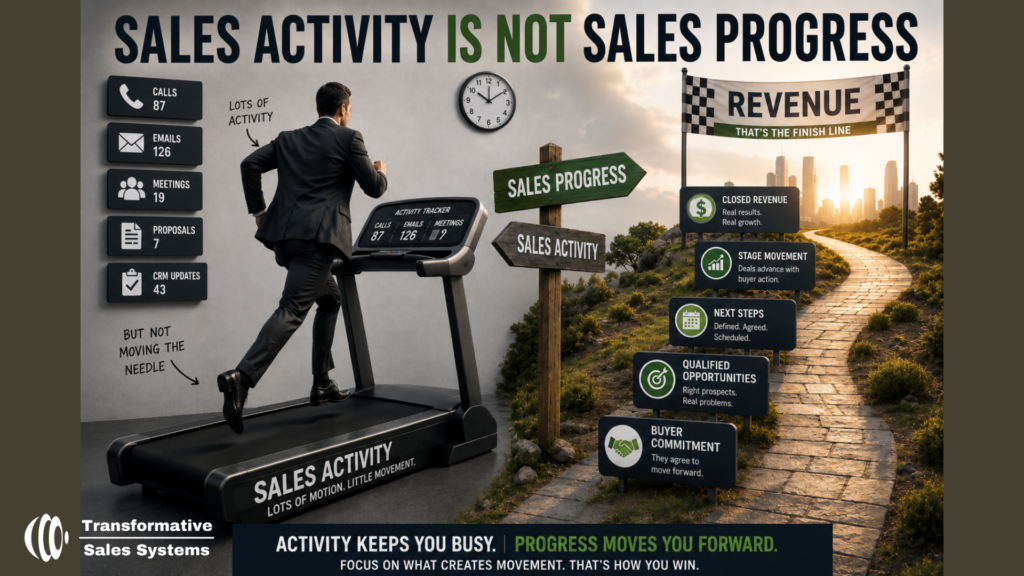
Your sales team may be busy, but that does not mean they are moving revenue forward.
This is one of the biggest disconnects I see when working with small and midsize businesses. The CEO or business owner looks at the team and sees sales activity. Salespeople are making calls. Emails are going out. Proposals are being sent. CRM notes are being updated. Meetings are happening. Follow-up reminders are being completed.
On the surface, it looks like sales is working, but then the revenue does not show up.
The pipeline looks full, but deals are not closing. Salespeople are active, but qualified opportunities are not increasing. Proposals are being sent, but too many go quiet. Forecasts are optimistic, but missed month after missed month. The team is busy, but the business is not seeing the results it needs.
That is because sales activity is not the same as sales progress.
Activity matters. I am not suggesting otherwise. Sales is not a spectator sport. Salespeople have to prospect, follow up, meet with prospects, enter information into the CRM, ask good questions, send proposals when appropriate, and move opportunities forward.
But activity only matters when it creates movement.
If activity is not creating qualified conversations, buyer commitment, better opportunities, clearer next steps, improved conversion rates, and revenue movement, then the sales team may simply be confusing motion with momentum.
And that is dangerous.
Sales Activity Metrics Matter, But They Are Not the Whole Story
Sales activity metrics are important because they show whether the team is doing the work. Calls, emails, meetings, proposals, LinkedIn touches, follow-up tasks, CRM updates, and prospecting attempts all give sales leaders visibility into effort.
You need those numbers.
A salesperson who is not making calls, not following up, not prospecting, not meeting with prospects, and not updating the CRM is probably not going to create consistent results. Activity is part of the job.
But sales activity metrics are leading indicators. They are not the final scoreboard.
The final scoreboard is revenue, margin, new customers, retained customers, close rate, sales cycle length, qualified pipeline, and profitable growth.
The problem is that many companies stop too early in their inspection. They ask, “How many calls did you make?” but they do not ask, “What did those calls create?” They ask, “How many proposals went out?” but they do not ask, “Were those opportunities truly qualified before the proposal was sent?” They ask, “How many meetings happened?” but they do not ask, “Did the buyer commit to a next step?”
That is where sales management has to go deeper.
It is not enough to know whether the activity happened.
You have to know whether the activity worked.
Busyness Can Create the Illusion of Progress
Measuring busyness is easy. Measuring sales progress takes more discipline.
Busyness gives the illusion of control. If a salesperson made 50 calls this week, it feels like something productive happened. If they sent 15 follow-up emails, it feels like the process is moving. If they sent five proposals, it feels like the pipeline is healthy.
Maybe it is.
Maybe it is not.
A salesperson can make 50 calls to the wrong prospects. They can send 15 weak follow-up emails that say nothing more than “just checking in.” They can send five proposals to people who were never qualified, never had urgency, never had authority, and never agreed to a real next step.
That is not progress.
That is activity dressed up as productivity.
Here is a simple example. One salesperson makes 60 calls in a week and books one meeting with a prospect who is not a great fit, has no budget, and is mostly “just curious.” Another salesperson makes 25 calls and books three conversations with prospects that match the ideal customer profile, have real business issues, and agree to a defined next step.
Who had the better week?
If all you measure is activity, the first salesperson looks stronger. If you measure effectiveness, the second salesperson clearly created more value.
That is the difference between managing activity and managing sales performance.
This is where many CEOs get misled. They see effort and assume the team is doing the right things. But effort by itself does not guarantee progress. Effort has to be aimed at the right prospects, with the right message, through the right process, with the right coaching and accountability behind it.
Otherwise, the team may be working hard and still losing ground.
Real Sales Progress Requires Buyer Movement
One of the best ways to separate sales activity from sales progress is to ask a simple question.
Did the buyer do anything?
Not the salesperson.
The buyer.
Did the buyer agree to another meeting? Did they bring in another decision maker? Did they share the information needed to move the opportunity forward? Did they confirm the business problem? Did they discuss budget, timing, or financial impact? Did they explain the decision process? Did they agree to review the proposal together instead of simply receiving it by email?
Sales progress requires buyer movement.
This is where many pipelines get inflated. Salespeople move deals forward in the CRM because they did something. They made a call. They had a meeting. They sent information. They sent a quote. They followed up.
But the buyer did not commit to anything.
That is not real pipeline movement.
Real sales progress happens when the buyer takes a step forward in the decision process. The salesperson’s activity should create that movement. If it does not, the deal may not be as strong as the salesperson thinks.
This is why CRM stages should not be based only on seller activity. They should be based on buyer behavior and buyer commitment.
If the buyer is not moving, the opportunity is not moving.
A Proposal Is Not Always Progress
This one may sting a little, but you need to hear it…“Sending a proposal is not automatically progress.”
In many sales teams, proposals are treated like a major sign of deal movement. A salesperson sends a proposal, and suddenly the opportunity feels more real. The deal may even move to a later stage in the CRM. The salesperson may talk about it in the sales meeting as something that has a chance to close.
But the real question is this: was the proposal earned?
A proposal sent after strong discovery, clear qualification, confirmed decision criteria, known stakeholders, budget understanding, urgency, and a scheduled review meeting can absolutely represent progress.
A proposal sent because the prospect said, “Send me something,” may represent the opposite.
It may be a sign that the salesperson failed to qualify.
Too many salespeople use proposals as a substitute for discovery. Instead of asking the hard questions, they send pricing. Instead of understanding the decision process, they send a quote. Instead of uncovering the cost of inaction, they send a document and hope the buyer figures it out.
That is not selling.
That is quoting.
There is a big difference.
For example, a prospect says, “Can you send me a proposal?” The average salesperson says, “Absolutely. I will get that over to you.” The stronger salesperson says, “I can, but before I do, I want to make sure what I send is actually useful. Can we walk through what you are trying to solve, who else is involved in the decision, and what you will be comparing this against?”
That second response protects the salesperson’s time. It improves the quality of the opportunity. It helps the buyer think more clearly. It also creates a better proposal if one is truly warranted.
A proposal should be a step in the sales process.
It should not be used to avoid the sales process.
“Just Checking In” Is Not a Sales Strategy
If there is one phrase that should make sales managers cringe, it is “just checking in.”
I understand why salespeople use it. They sent a proposal. They have not heard back. They do not want to be too pushy. They need a reason to follow up. So they send the familiar email.
“Just checking in to see if you had a chance to review the proposal.”
The problem is that this type of follow-up rarely creates progress. It puts all the responsibility on the buyer to restart the conversation. It does not add value. It does not create urgency. It does not reframe the business issue. It does not clarify the decision process. It does not advance the opportunity.
It is activity.
But it is weak activity.
A better follow-up should reconnect to the buyer’s business problem and create a reason to continue the conversation.
For example, instead of saying, “Just checking in,” the salesperson could say, “When we spoke, you mentioned that delayed response times were causing customer complaints and forcing your operations team to spend extra time resolving issues. That sounded like the main reason this was becoming more urgent. Would it make sense to review the proposal together and compare it against the impact of leaving the current process unchanged?”
That is a different kind of follow-up.
It reminds the buyer why the conversation started. It connects to business impact. It creates a reason for a meeting. It gives the salesperson a stronger position than simply hoping the buyer responds.
Sales progress usually comes from meaningful next steps.
Not just polite reminders.
Sales Productivity Is Not Just Doing More
Sales productivity is often misunderstood.
Many people define sales productivity as doing more in less time. More calls. More emails. More proposals. More meetings. More CRM updates. More touches.
That can matter, but it is incomplete…true sales productivity is not just doing more.
It is producing more meaningful sales outcomes from the right activity.
A salesperson who doubles their activity but does not improve qualification, conversion, or revenue has not really become more productive. They have become busier.
This matters even more now because sales technology and AI can help teams create more activity faster. Salespeople can generate more emails, automate more follow-up, summarize more calls, and update more CRM records. That may improve efficiency, but efficiency is only valuable when the team is doing the right things.
Doing the wrong things faster is not progress.
It is just faster failure.
This is why sales productivity has to be connected to the sales process. The goal is not more activity for its own sake. The goal is better activity that creates qualified opportunities and moves real deals forward.
The Numbers Should Tell a Story
CEOs and business owners should absolutely look at sales activity metrics. But they should not stop there.
The better approach is to look at activity, quality, conversion, and progress together.
It is useful to know how many calls were made, how many emails were sent, and how many meetings were booked. But those numbers become far more useful when they are connected to conversion rates, qualified opportunities, proposal-to-close rate, average deal size, sales cycle length, stalled opportunities, and closed-won revenue.
For example, if call activity is high but qualified opportunities are low, there may be a targeting, messaging, or skill issue. If meetings are happening but few opportunities are advancing, discovery may be weak. If proposals are high but close rates are low, qualification may be poor or proposals may be going out too early. If the pipeline is large but revenue is flat, the pipeline may be inflated with stale or weak opportunities.
This is where the numbers become useful. They are not just reporting tools. They are coaching tools.
A good sales manager uses metrics to find the constraint and then they coach the behavior behind the number.
That is what separates sales reporting from sales leadership.
Pipeline Reviews Should Inspect Reality
A pipeline review should not be a storytelling session and unfortunately, that is what many pipeline reviews become. The salesperson explains the deal. The manager asks when it will close. The salesperson gives a hopeful answer. Everyone moves on to the next opportunity.
That is not pipeline management.
That is pipeline story time.
A strong pipeline review inspects reality. What problem is the buyer trying to solve? Why does it matter now? What happens if they do nothing? Who is involved in the decision? What is the decision process? What criteria will they use to choose? What is the next step? Is that next step buyer-owned or seller-owned? When is the next meeting? What evidence do we have that this deal is moving?
Those questions separate real opportunities from hopeful ones.
Here is what this looks like in practice. A salesperson says, “This one is looking good. I sent the proposal last week, and they seemed interested.”
That sounds positive, but it is not enough.
The manager should ask, “What did they agree to do after receiving the proposal?”
If the answer is, “They said they would review it and get back to me,” that is not a strong next step. The deal may still be alive, but it is not as strong as the salesperson thinks.
A better answer would sound like this: “We reviewed the proposal with the operations manager and CFO. They agreed the current issue is costing them about $8,000 per month in rework and missed deadlines. They asked us to revise the implementation timeline and scheduled a follow-up meeting next Thursday to make a final recommendation to the owner.”
That is progress.
There is buyer involvement, business impact, next-step commitment, and a defined path forward.
That is the kind of difference sales management has to inspect.
Sales Managers Must Coach Quality, Not Just Quantity
It is easy for a sales manager to tell the team to make more calls.
Sometimes that is necessary.
But if the quality is poor, more calls may not solve the problem.
Sales managers have to coach the behaviors that create better outcomes. That includes prospect targeting, opening statements, discovery questions, listening skills, qualification, handling objections, creating next steps, proposal discipline, and follow-up strategy.
If a salesperson is not creating enough qualified opportunities, the answer may not simply be more activity. It may be better messaging. It may be a stronger ideal customer profile. It may be call reluctance. It may be poor questioning. It may be that the salesperson is talking too much. It may be that they are chasing anyone who will speak with them instead of focusing on the right prospects.
This is why sales coaching matters.
You cannot manage sales effectively from a spreadsheet alone. The numbers tell you where to look. They do not tell you everything you need to know.
A sales manager has to listen to calls, review emails, inspect CRM notes, role-play difficult conversations, and ask salespeople to explain their thinking. Not to micromanage them, but to improve them.
Sales leadership is not just asking, “Did you do the activity?”
Sales leadership is asking, “Did the activity create the right result, and if not, what do we need to improve?”
That is a much better conversation.
Accountability Requires Standards
Accountability is not just asking salespeople what they are working on.
Accountability means there are clear expectations, clear metrics, clear standards, and clear consequences.
The salesperson should know what activity is expected. They should know what a qualified opportunity looks like. They should know what information belongs in the CRM. They should know what must happen before a proposal is sent. They should know what defines movement from one stage to the next. They should know how success is measured.
Without that clarity, accountability becomes subjective.
The manager says, “You need to do better.”
The salesperson says, “I am working hard.”
Both may be telling the truth, but nothing improves.
A clear sales process removes some of that ambiguity. It creates a common language for performance. It helps the manager coach more effectively and helps the salesperson understand what good looks like.
That is why activity metrics have to be tied to standards.
Not just volume.
Standards.
What CEOs Should Be Asking
If you are a CEO or business owner, you do not need to become the sales manager. But you do need to understand whether your sales team is creating real progress or just staying busy.
A few questions will tell you a lot.
- Are we measuring sales activity only, or are we also measuring conversion and progress?
- How many new qualified opportunities did we create last month?
- What percentage of our pipeline is truly qualified?
- How many open opportunities have no defined next step?
- How many proposals were sent before the opportunity was fully qualified?
- What percentage of proposals are closing?
- Where are deals most commonly getting stuck?
- Are salespeople creating buyer-owned next steps?
- Are our CRM stages based on seller activity or buyer commitment? A
- Are sales meetings improving performance or just reviewing updates?
Those questions expose the difference between effort and effectiveness and you may find that the team is not doing enough activity. That happens.
But you may also find that the bigger issue is not activity volume. It may be activity quality, poor qualification, weak messaging, lack of coaching, or a sales process that does not create buyer movement.
That distinction matters.
Because the solution is different.
Activity Is Necessary. Progress Is the Goal.
I do not want this article to be misunderstood.
Activity matters.
Salespeople need to prospect. They need to follow up. They need to have conversations. They need to create opportunities. They need to update the CRM. They need to send proposals when appropriate. They need to do the work.
But activity is not the destination.
Activity is the input.
Progress is the goal.
Revenue is the result.
The job of sales leadership is to connect those three things. The right activity should create the right progress, and the right progress should create the right revenue.
When that connection is broken, sales teams become busy but ineffective. They work hard, but results stay inconsistent. They send proposals, but deals stall. They have meetings, but opportunities do not move. They fill the pipeline, but the forecast cannot be trusted.
That is not always a sales effort problem.
Very often, it is a sales management problem.
The Bottom Line on Sales Activity Metrics
Sales activity metrics matter, but they are not enough.
A busy sales team is not automatically a productive sales team. A full calendar is not a healthy pipeline. A high number of proposals is not proof of strong selling. A CRM full of opportunities is not the same as qualified revenue potential.
CEOs and sales leaders need to look beyond activity and inspect whether the work is creating movement.
Are the right prospects being contacted? Are better conversations happening? Are opportunities being qualified properly? Are buyers committing to next steps? Are proposals being earned? Are deals moving for real reasons? Is the pipeline becoming more accurate? Is revenue improving?
That is how you separate activity from progress.
The sales teams that win will not simply be the teams that do more. They will be the teams that do the right things, with the right prospects, at the right time, in the right way, with the right management cadence behind them.
Activity matters.
But sales progress pays the bills.
Call to Action
If your sales team is busy but revenue is not moving the way it should, it may be time to look deeper than activity metrics.
Transformative Sales Systems helps small and midsize businesses build the sales leadership, process, coaching, and accountability needed to turn sales activity into real sales progress.
Before you ask your team to do more, make sure the work they are doing is creating the right movement.
FAQ Section
What are sales activity metrics?
Sales activity metrics are measurements of the actions salespeople take, such as calls made, emails sent, meetings booked, proposals sent, follow-up tasks completed, CRM updates, and prospecting touches. These metrics help sales leaders understand effort and consistency, but they do not tell the full story of sales performance.
Why are sales activity metrics important?
Sales activity metrics are important because they show whether the sales team is doing the work required to create opportunities. However, activity metrics should be reviewed alongside conversion rates, qualified opportunities, buyer next steps, pipeline movement, close rates, and revenue results.
What is the difference between sales activity and sales progress?
Sales activity is what the salesperson does. Sales progress is what changes as a result of that activity. Real sales progress usually includes buyer movement, such as a confirmed next step, a qualified opportunity, a decision-maker joining the process, a proposal review meeting, or a deal advancing based on buyer commitment.
Can a salesperson have high activity but poor results?
Yes. A salesperson can make many calls, send many emails, and submit many proposals without creating meaningful sales progress. This usually points to issues with targeting, messaging, discovery, qualification, follow-up strategy, or sales coaching.
What sales performance metrics should CEOs track?
CEOs should track both activity and effectiveness. Important sales performance metrics include qualified opportunities created, conversion rates, proposal-to-close rate, sales cycle length, average deal size, stalled opportunities, opportunities without next steps, close rate, gross margin, and closed-won revenue.
Why are proposals not always a sign of sales progress?
Proposals are only a sign of progress when they follow proper qualification and clear buyer commitment. If a proposal is sent too early or simply because the prospect said, “Send me something,” it may indicate weak discovery rather than real opportunity movement.
How can sales managers improve sales progress?
Sales managers can improve sales progress by coaching the quality of activity, inspecting pipeline reality, reinforcing qualification standards, reviewing sales conversations, improving messaging, holding salespeople accountable, and making sure CRM stages reflect buyer commitment instead of seller activity.
Transformative Sales Systems
812-924-7085
Schedule a 30 minute meeting: https://calendly.com/anthony-nicks/30min
Learn more about Fractional Sales Management at https://transformativesalessystems.com/sales-leadership/
Read more about Fractional Sales Management: https://www.amazon.com/dp/B0FLWSXX5D